

We don’t have the means to provide everyone a certain level of healthcare. So who should be provided at what level, and how should we decide?
George Rebane
A compellingly reasonable way to make a decision or select from among alternatives is to maximize some measure of utility that each of the alternatives is expected to yield when chosen. Devising a healthcare system for a nation should also follow this path. Here the alternatives can range anywhere from total free market laissez faire to comprehensive healthcare systems run by autocratic governments.
Utility is a bit tricky in the sense that we must always be aware of whose utility it is we are talking about. If we are to consider a national healthcare utility, we don’t want to devise the healthcare utility metric (HUM) in such a way that from the gitgo it reflects the utility to a select individual, group, or even the state. If we do that, then it immediately limits the choices we have available.
For example, if we formulate the HUM to heavily weight dollar cost to the government, then we may be driven toward nationalized healthcare schemes, or even the other way altogether. An attractive and easy to understand alternative is to consider the HUM from the perspective of the healthcare consumer, but one that is not quite the Average Man who, say, has already avoided all the childhood diseases and has yet to enter the aging phase with its degenerative maladies that ultimately lead to death.
Perhaps a Mosaic approach would then suit us. Think of Moses, after 40 years of wandering in the wilderness with the 12 tribes of Israel, he comes to the edge of civilized kingdoms in the Promised Land and has to pick one into which to direct his people who fall into all the normal demographic and state-of-health categories. Recall, that Moses doesn’t get to go along, so that his decision will not reflect any biases toward, say, good eldercare. Moses is only concerned about the future welfare of his people as it is affected by the selected country’s scheme of delivering healthcare.
Clearly, Moses wants his people to have long and fruitful lives. ‘Fruitful’ involves factors beyond healthcare, however, the ‘length of lives’ can be directly influenced by the kind of healthcare people can get as they go through life. So let’s put some measure of aggregate lifespan on the list of potential attributes to be included in the HUM.
Puzzling further, Moses mulls over the quality of life and, remembering a humorous tale with a message, quickly concludes that long life by itself may not be satisfactory unless in it we may, in some sense, be able to experience happiness and joy. People with chronic illnesses in the wilderness did not look like they were enjoying themselves too much; in fact, some prayed for God to take them sooner than later. (The humorous tale? You heard about the contest where the first prize was an all expenses paid, one week visit to Pittsburg. The second prize was a two week visit.)
So Moses decides to include morbidity in the HUM he is designing. Morbidity is the fancy word for the duration of illnesses. Thinking further, it occurs to him that it’s most important that people in the productive years – creating wealth and raising children – suffer the least from morbidity. He can feel it in his own bones that almost all of us in old age begin to suffer various degrees of morbidity that ultimately lead to mortality. But since those old codgers are supposed to die anyway, he will put less weight in the HUM on post-productive morbidity. While in this line of thought, he also decides that pre-productive age children’s morbidity should receive less weight. So he’s decided that morbidity will be a three-tiered attribute in his HUM.
Thinking back on long life and the state of anticipated medical technology, he will include long life in the form of mortality rates for different age groups. After all, mortality rate is a factor that aggregates so many other aspects of healthcare technology and services, that it really doesn’t pay to go into too many other contributing sub-factors for the HUM. Moses decides to wrap longevity also into a three-tiered attribute of mortality rates for the same age groups he picked for morbidity. Again, he will weight the tiers in the general order of favoring low mortality for the productive years. Moses knows that no one escapes out of the geriatric group alive, and that young kids are cheap and easy to replace, but he doesn’t talk aloud about such thoughts.
Having gone through all this thinking, Moses is almost ready to start getting down into some quantitative math on his HUM when it comes to him that good healthcare systems must also have good track records. Given the conceptual level of his HUM so far, what would a good track record look like? Being no dummy, he immediately thinks of the changes over time of his mortality and morbidity factors. Good healthcare systems would show that over the years mortality and morbidity rates would be decreasing (the so-called ‘deltas’). Most certainly they would not be increasing for that would give the first hints of those schemes being unsustainable, and sustainability is one factor that Moses wants to include. He decides that choosing an appropriately long time interval over which to measure the deltas would implicitly factor sustainability into his HUM.
At this point Moses is feeling pretty good and is looking forward to Miller time. He feels even better when he considers that he didn’t have to explicitly include any shekel costs in his HUM since these would all be incidental to and included in what is delivered through the performance of the healthcare system’s mortality and morbidity rates. So the shriek for the shekel (precursor of bang for the buck) is already baked into his HUM through the tiered attributes and their deltas. With this nice bow tied on the package, Moses decides to reward himself with a beer and a bump by adding a shot of Jack Daniel to his libations, and then hits the sack. Tomorrow he’ll scribble down the HUM equation and formalize the whole thing before sending off his lieutenants into the candidate countries to size them up and collect the data for his HUM.
After breakfast the next morning Moses calls his mathematically inclined scribe and dictates the following HUM, which incorporates a few added thoughts he had between the beer and the bump, and sweet dreams of healthcare systems hither and yon.
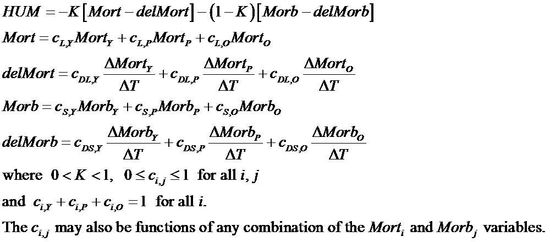
The math scribe took it all down dutifully, but when they were done he advised Moses not to show this to anyone lest they have a riot on their hands. Moses agreed that the introduction to his HUM and the instructions on its care and feeding would need some salesmanship. Forty years in the wilderness had not produced that many numerates among the Israelites who remembered their high school algebra.
And just in case God decided to call him home a bit early, Moses took the time to explain the HUM to his math scribe so that all would not be lost. This is what he said.
“Shlomo, listen up! In the first line the stuff in the square brackets are the mortality rate and the rate of change in these rates over deltaT years. Since we are looking for the maximum HUM value, the change in mortality rates enters as a negative. Why? Because good changes in mortality rates go down over the years, they are negative. And you do remember that minus times a minus gives you a plus, so negative mortality rates will add, capiche? Finally, the whole expression is negative because higher mortality rates are worse that lower ones.
The same goes for the stuff in the second square brackets which covers what I said about morbidity rates and how they have changed over the years. The K is a weighting factor that lets us express the relative importance of mortality and morbidity with respect to each other. The same goes for the little c’s in the following lines. All of them are weights that we’ll later attach to the various categorical (young, productive, old) mortalities and morbidities. How will we do that you ask? Well, I’m going to assemble all elders and leaders of the tribes and go through a rigmarole that will be well known to smart guys like you in about 3,500 years. Think of it as a big focus group. What’s a focus group? Never mind; just think of it as a big coffee klatch at the end of which we will have the values for all the weightings that my HUM will require. You can bet it will be, shall we say, a spirited discussion. Make them leave anything that can stab or cut at the door, pat them down.
So in the second line we have the mortality factor broken down and weighted into the Young, Productive, and Old categories. The third line does the same with the categorical mortality rate changes. Note that the constants for the second and third lines can be chosen independently – that’s what is going to cause all the gnashing of teeth and rending of garment by the time they’re done.
The fourth and fifth are like the second and third lines, only they apply to the morbidity factor in the HUM. And that’s pretty much it. All the other stuff is just to remind everyone that the weightings at each level and in each category are non-negative, and have to add to unity or one. Otherwise things will really get screwed up. And, oh yes, tell them that they will also have to determine the delta T value of the number of years over which the change in the rates will be measured. That will depend on how well each country kept its records. Anyway, that’s it, go forth and all that, come back with questions if you really have to. Vaya con Dios.”
After that piece of work Moses took a nap and had a dream in which God again spoke to him. Without getting too much into scripture here, the essence of God’s message was that the HUM he had inspired Moses to construct could also be used to design a brand new healthcare system from scratch. Such a system might even be better than any of the ones his scouts brought back from the Promised Land. Bottom line, pick the best out there, and if that’s not good enough come up with your own. God went into the details of how to use people called ‘domain experts’ to come up with expected mortality and morbidity rates, etc, of a newly designed system and plug them into the HUM. In fact, using the HUM would even tell them what parts of the healthcare system they had to modify in order to increase their expected shriek for the shekel, or anything else they considered important.
About a month later the Israeli scouts returned with all the healthcare data from the kingdoms. Moses and the math scribe plugged in the numbers and cranked out the various HUM values. They both looked at each other and shook their heads. Moses told the scribe to go get Joshua and leave them alone for a bit.
When Joshua left Moses with his marching orders, he saddled up, got all the young hotshots in the twelve tribes formed into a very long column of twos, and then led them down to Jericho. The story from here gets pretty gory. For not having healthcare systems that measured up to snuff, the Jews took down kingdom after kingdom and founded Israel. Then they used the Healthcare Utility Metric Moses had given them to come up with a super healthcare system, and the rest is history. Now you know.


 rebanesruminations.com
Leave a comment