

George Rebane
Big government’s (centrally controlled) social programs have a daunting history of failures that more often than not spill over to spread their hurt into other unintended areas. An excellent example of this – ‘The State Against Blacks’ – is given by economist Walter Williams in the 22jan11 WSJ. Today we have entered the epoch of large government programs that range from long-entrenched farm subsidies through various targeted welfare and ‘stimulus’ programs to nationalized healthcare. In this piece I would like to give a scientist’s view of how to look at and think about such programs with the goal of understanding their large-scale operational characteristics. And further, how eventual failure is built into the very structural make-up of every such program.
From the gitgo I have to declare that this will not be an easy read, and damn near impossible for the innumerate (see numeracy). My apologies are tempered by the reality that EVERY significant social issue comes down to understanding ‘the numbers’ involved in its framing and implementation. Here ‘the numbers’ actually refer to a broader toolset from the system sciences. So let’s dive in.
We begin by positing that every tax funded, government designed and operated social program is designed to benefit a ‘deserving’ cohort of people, and exclude the ‘undeserving’ cohort. Because it costs money to benefit everyone served by the social program, the government has to discriminate between the Deserving and the Undeserving, else the program will quickly spend more than budgeted, or be unsustainable and go broke. Examples of such government programs abound.
Given this basis, the social program’s design must include operationally usable definitions of the Deserving with respect to the program’s goals, and the attendant presumption that if you are not of the Deserving, then you belong to the Undeserving. The social program’s design also includes elements that define its operational structure including who will vet the Deserving from all the applicants, and how the program’s benefits will be delivered to the successful applicants – we’ll call them the program’s Recipients and the unsuccessful applicants will be labeled the Rejects. All of these considerations will make up the program’s policy, which includes what we may view as an operational threshold comprised of multiple explicitly defined factors used to cull the applicants into the Recipients and the Rejects.
And here comes the realworld rub. Almost all such human-devised programs (they can be formally viewed as systems) are prone to imperfections and errors in their design, construction, and application. We will here focus on two types of errors arising from the operation of the program that will ultimately be reflected in the program’s cost and, therefore, feasibility/sustainability. The first type of error – let’s call them Type1 errors – is that in vetting the applicants we will refuse some Deserving people and assign them to the Rejects. The second type of error – calling them Type2 errors – will cause the acceptance of some Undeserving applicants and assign them to join the Recipients.
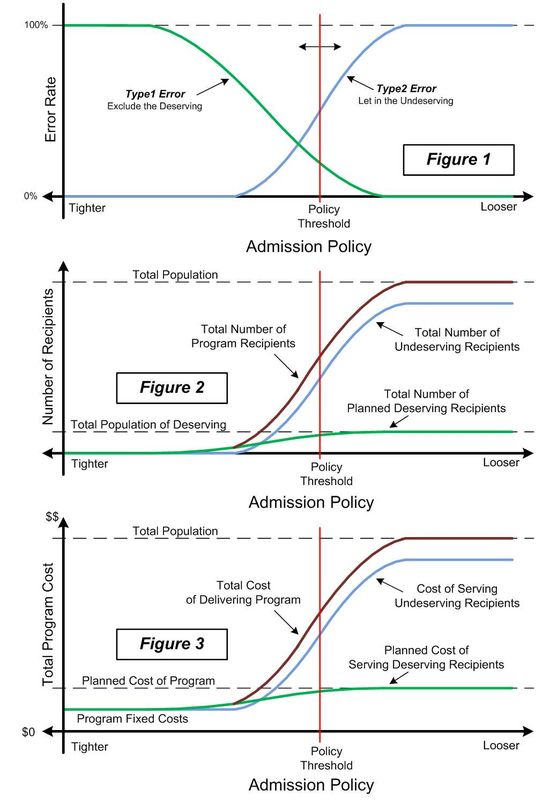
Now when we consider these errors in terms of the program’s admission policy, we intuitively grasp that if we make that policy too tight, we will reject too many of the Deserving which translates into having an excessive Type1 error rate. In response to this we can loosen the acceptance threshold and immediately see a drop in Type1 errors as we accept more Deserving people into the program as Recipients of its benefits. The unfortunate counterpart to loosening acceptance policy is that we begin to accept some of the Undeserving into the ranks of the Recipients, in other words our Type2 error rate begins to rise.
The scheme of things should now start becoming clear. The operation of realworld programs (systems) is almost always so that as you loosen your admission threshold to minimize Type1 errors (reduce rejection of the Deserving), the inevitable result is that you increase Type2 errors by letting in more and more of the Undeserving. Only fools and politicians will argue at the onset of the next social program that such a situation will be eliminated by all manner of hokey prudence. The interplay of Type1 (green) and Type2 (blue) errors is illustrated in Figure 1.
[At this point the technically astute reader will already recognize the direction of this explication as it parallels the technical developments in signal processing and generalized experiment design. Yes, we are heading toward the beloved ROC Curve.]
Looking at Figure 2, we can draw the total Recipients population curve consisting of the Deserving and the Undeserving, again as a function of the program’s admission policy. At any given time the total Deserving population is usually a (small?) fraction of the country’s total population or a sub-population (e.g. people of African descent). So multiplying such a population by the complement of the Type1 error rate (i.e. one minus Type1 fractional error) lets us plot the number of Deserving Recipients in the program as a function of how tight or loose we make our admission threshold. This is shown as the green curve in Figure 2.
But we know from Figure 1 that at any given acceptable admission threshold we will also have a positive Type2 error rate. Multiplying this error rate by the total population of the Undeserving will give us the number of these people included in the program Recipients. This is shown as the blue curve in Figure 2. Adding the Deserving and Undeserving Recipients will give us the total number of Recipients in our program who receive benefits. Depending on how loose the admission policy threshold is made, the total number of Recipients can approach the total population of the country.
The problem now begins to reveal itself as we consider the size of the Undeserving Recipient cohort. Because the total population of the Undeserving is usually very large, even a very low Type2 error rate will admit a surprisingly large number of such recipients into the program. And we always have to keep in mind, that attempting to tighten up on admissions (e.g. the popular ‘eliminating fraud and corruption’ argument) will inevitably increase Type1 errors and exclude some of the people we want to receive benefits.
All of this is comes down to dollars and cents, and its effect on program cost is shown in Figure 3, again plotted against the now familiar admissions policy axis. The vertical axis may be scaled in either total program cost or its cost rate (say, dollars per year) of the social program. The latter being important when the program competes annually with other programs for a share of some overarching budget. But the real takeaway should be understanding how the attempt to benefit all the Deserving becomes impossibly (or is it outrageously?) expensive as we try to capture that last percent or two. Somewhere the line must be draw no matter the tears.
In sum, when we line up the different curves of Figures 1, 2, and 3, we see how the real world of social programs operates. And all this should be understood before we begin to consider how humans game all systems, where the tragedies of the commons arise, how such programs are constructed and must needs be operated by government workers who definitely are not among the brightest bulbs on the tree.
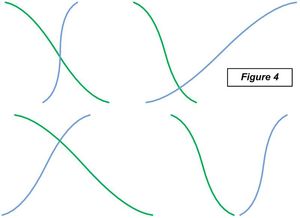 Before concluding, I have to point out that the actual error curves of Figure 1 can come in various shapes and forms. Most certainly they are never nicely symmetric as I have shown here for illustrative purposes. More than likely they are as shown in Figure 4 which emphasize the different rates at which Type1 and Type2 errors vary as the admissions threshold is changed. The one thing you should never plan on is that the error curves will look like the ones in the lower right of Figure 4. Here it is easy to devise an admissions threshold in the ‘valley’ where both error types are zero – a perfect piece of social engineering. People who attempt to convince you that their social program will have such a valley, and admit only the Deserving while reliably rejecting the Undeserving, are either charlatans, liars, thieves, or simply the well-meaning ignorant. None of them belong in public service.
Finally, we can combine the Type1 and Type2 errors for a social program into a single curve that represents how efficiently it will trade off serving the Deserving at the expense of also serving the Undeserving. The combined curve shown in Figure 5 is the analog of the Receiver Operating Characteristic (ROC) curve devised in the early days of radio. To fit within our context, I will rename it the Social Program Effectiveness Tradeoff (SPET) curve. Over a spectrum of defined admissions policies each program will yield the appropriate error curves introduced in Figure 1. Than as seen in Figure 5, the SPET curve plots the fraction of Deserving (1 – Type1) against the fraction Undeserving (Type2) that the program will admit. The SPET curve is generated from the Figure 1 error curves by plotting their indicated values as the admissions threshold is swept from the tightest to the loosest policy.
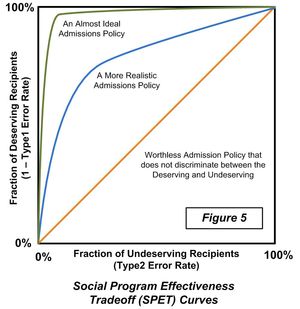 Each social program will intrinsically operate within the Type1 and Type2 errors shown in Figure 1 and combined into its SPET curve as shown Figure 5. All that program management can do then is pick an ‘operating point’ for the program in terms of its admissions policy. That selects a point on its SPET curve and everyone is off to the races. It takes some work, but these error curves can indeed be estimated as the social program is designed, and the information on its admissions and cost tradeoffs made as I have described above. The embarrassing question at this point is, how many programs receive such consideration before Congress and then some bureaucracy launches into the next spending spree costing hundreds of billions of dollars. Does anyone think that this was done before Obamacare was committed into thousands of pages of unread and still not understood legislation?
As voters we will continue to be subjected to hyper-ventilated arguments to move the admissions threshold this way or that by the citing of anecdotal and heartrending evidence of the current policy rejecting some pitiful Deserving person(s). And the obverse citations of how some callous and greedy Undeserving have been receiving benefits, therefore advising that admissions should be made stricter. As Walter Williams says in the above linked article, “Politicians exploit economic illiteracy.”
Considering the above, we should now be able to understand the factors that underlie all such social programs and demand that we receive usable information (fixed and variable costs, size of populations, admissions criteria, error rates, success metric of similar programs, …) from our politicians and bureaucrats before deciding whether to open or close our wallets to their always compelling entreaties. The alternative is to continue as we have been, leaving reason by the wayside.


 rebanesruminations.com
Leave a comment