

George Rebane
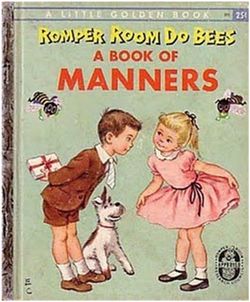 Back in the stone age when we were young, a lot of emphasis was put on teaching children how to behave in various social situations. And we were taught that there existed different kinds of social settings in which this behavior was OK, that behavior was required, and those behaviors were definitely ‘out of place’. Our lives then had different kinds of places.
As a boy, I was taught that I was different from a girl, and that it was my responsibility always to show certain deferences to the opposite sex. Girls were equally instructed about boys. We had definite roles to play which would grow and change as we grew. All of those roles might be called formalisms, and could be gathered under the canopy of a culture – our culture.
So instructed, one of the many benefits we kids had was that we knew how to ‘be’ in literally any situation in which we found ourselves. I looked forward to being taken to various observances, celebrations, meetings, and other purposive gatherings. I knew how to greet people, what to say and do. I knew my place, and everyone else there also knew my place and respected me when I maintained it properly. From my secure place it was a blast to see the adults do their thing with each other, most trying to maintain their places, some trying to achieve a better place, and a few even falling out of place. I was learning all about places that people had in my culture, and also what it took to get from one place to another. Adult watching was a lot of fun, and profitable as I entered the job market – first as a paperboy, then as a farm hand, and on into a machine shop as the only kid at a work station. We kids knew what to do when.
Over the years since then our culture has come to judge formalisms as being somehow restrictive, artificial, and unnatural. Everyone gets to do pretty much what they want in most social situations. To keep everyone more or less in line, we have given up common cultural norms for state enforced legal boundaries that maintain our social behaviors. The range of such permitted behaviors, from free-wheeling to culturally constrained to criminal conduct, has gotten narrower. Today the cultural buffer between the unpredictable free-wheeling to criminality has almost disappeared. Since an applied and enduring culture is now passé, we proceed directly from just doing your own thing, to doing it in jail.
Peggy Noonan ruminated about the role of society’s formal behaviors in a recent piece – ‘The Captain and the King’ – where she focused on the importance of knowing and maintaining what is required of the roles each of us play on the world’s stage. No matter how loosey-goosey about such things we have become, most people still know, almost instinctively, what appropriate behavior is when you assume this mantle or that. But the active denial of that knowledge, I think, is a large part of our social discord today.
When arriving at a political dictum which states that in a closely packed society all cultures are of equal worth, then it often turns out that no culture is of any worth at all. We begin yelling at each other to shape up and fly right according to what we (mis)understand to be written in the statutes, ordnances, and regulations. And given the inability to invoke shame as a traditional cultural corrective, we launch legions of lawyers in order to bring the state’s power of the bayonet to bear against each other. And of all this, the headlines bear witness.
But the record of our country’s cohesive popular culture is still there, and available to everyone. Certain parts of it we can leave within the pages of history, but to our benefit most of it we can resurrect. We can start teaching it once more in our schools, places of worship, and civic organizations. And we can start applying it in the many roles that each of us plays in our daily round and in the larger span of our lives. To our mutual benefit across the land, perhaps it might even catch on.


 rebanesruminations.com
Leave a comment