

George Rebane
This weekend (4,5 Dec) at Caltech’s Beckman Institute there will be a Humanity+ conference with the intriguing title ‘Redefining Humanity in the Era of Radical Technological Change’. They plan to stream the presentations live. Please check this site for conference information and streaming links.
Two aspects of radical technological change were recently announced. The first was the formulation of a psychological theory that provides a “new explanation of how humans solve problems creatively — including the mathematical formulations for facilitating the incorporation of the theory in artificial intelligence programs — provides a roadmap to building systems that perform like humans at the task”. This is a major step toward overcoming the long held skepticism about whether computers could achieve peer intelligence with humans. Creativity in the various fields of human cognition has always been a hallmark that separates us from other critters, and most certainly from machines. More here.
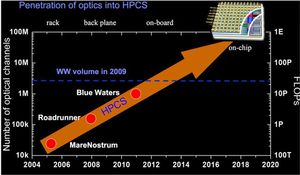 The software that will be written to implement the new discovery called ‘Explicit-Implicit Interaction Theory’ will need a computer that can at least match the processing power of the human brain. This is estimated to be around ten petaflops, or 10^16 = 10,000,000,000,000,000 floating point operations per second. Think of a flop as multiplying two long decimal numbers with a lot of digits.
Well, it turns out that the fastest supercomputers made by the Chinese and Americans have achieved petaflop (10^15) speed levels. But recently there has been a lot of work done in the field of nanophotonics. This is the technology of controlling data-carrying light beams at the nano-scale that can be incorporated into a new generation of computing chips. Using light instead of electricity allows data to be transported faster inside the chip, and also to use less power. Billions of tiny electric currents going along little leads or wires generates lots of heat. That’s what makes the fan speed up in your computer when you do stuff like streaming video or making your pictures look pretty.
And now the announcement comes from IBM that they have advanced nanophotonics to the level that will allow its incorporation into ultra-fast computer chips. They estimate that by 2018 advanced computers will operate at exaflop levels. That is one hundred times faster than the human brain, or 10^18 = 1,000,000,000,000,000,000 flops (that’s a billion billions). There is every expectation that during this eight year interval we will have the ‘creativity software’ created and operating on the world’s fastest computers. More here.
It is anybody’s guess in these pre-Singularity years what ideas, solutions, and paradigms such computers will start spewing out when they are fed various kinds of data about our world and how we live.
Exit Exercise: Now put these notions together with what country will be doing what with what kind of talent in the maths and sciences. China has more students in the equivalent of our ‘advanced placement’ category than the US has students in all our schools – and these kids are not preparing themselves to be lawyers or art history teachers.


 rebanesruminations.com
Leave a comment