

George Rebane
QE2 used to be the short moniker of HMS Queen Elizabeth 2, flagship of Cunard’s luxury liners. You boarded QE2 and forgot your troubles as you were transported across The Pond with more comforts than you could imagine. Today’s QE2 is the code word most people hear and can’t put together with anything that might affect them, let alone cause them more discomfort than they can imagine.
QE2, the second tranche of ‘quantitative easing’, is planned to pump $600B more newly printed fiat money into the economy backed by nothing but the blather of the Obama administration. Coming from the Fed, it is intended to turn loose more money from the banks that have been using past bailouts and QE1 to fatten their reserves instead of making needed loans. The additional money is supposed to continue to ease interest rates and maybe even revive the housing market. Not a chance.
The real purpose of QE2 is to ‘monetize the debt’ – i.e. to continue destroying the value of the dollar so that our government’s (or should that be governments’) debts and unfunded liabilities can be paid off in worthless dollars that add to up to the quoted nominal amounts that are on the books for the Chinese, Japanese, … lenders and our legions of pensioners. In short, it is the quiet beginning of the last stage of government make believe that all is still well with our economy.
The thing here is to note that we have entered the dreaded Keynesian ‘liquidity trap’
“There is the possibility … that after the rate of interest has fallen to a certain level, liquidity preference is virtually absolute in the sense that almost everyone prefers cash to holding a debt at so low a rate of interest. In this event, the monetary authority would have lost effective control.” John Maynard Keynes, The General Theory.
Expanding on this, John Hussman of the Hussman Funds writes –
Alternatively, monetary policy might transmit its effect on the real economy by directly altering the quantity of funds available to lend. In that view, a liquidity trap would be characterized by the failure of real investment and output to expand in response to increases in the monetary base (currency and reserves).
In either case, the hallmark of a liquidity trap is that holdings of money become “infinitely elastic.” As the monetary base is increased, banks, corporations, and individuals simply choose to hold onto those additional money balances, with no effect on the real economy. The typical Econ 101 chart of this is drawn in terms of “liquidity preference,” that is, desired cash holdings plotted against interest rates. When interest rates are high, people choose to hold less cash because cash doesn’t earn interest. As interest rates decline toward zero (and especially if the Fed chooses to pay banks interest on cash reserves, which is presently the case), there is no effective difference between holding riskless debt securities (say, Treasury bills) and riskless cash balances, so additional cash balances are simply kept idle.
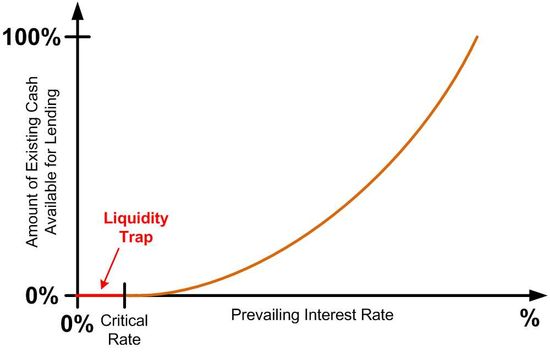
Let me describe this trap in an even simpler way. As interest rates approach zero, there is a critical level where everyone with money to lend says, ‘Why should I risk lending my money at such a low rate to someone who may not pay it back. The risk is not worth the reward, so I’ll just stick it under my mattress and sleep on it until I find something better to do with it.’ After reaching this low interest rate, all additional cash injected as stimulus will just be stashed away and not put to work growing the economy. We are almost there now, and that’s why QE2 won’t stimulate anything except the next stage of inflation. Keep your eyes on precious metals and commodities.
Over the last years RR readers have become familiar with my warnings (here 17may08, 13oct08, 2dec08, 11jun09, 22aug09, 12sep09, 6oct09, 12dec09, 01mar10) on the tactic – pay off expensive debt with cheap money – that all spendthrift governments throughout history have attempted as their last gasp before capitulation or invasion. I even proposed an operational monetary workaround for conducting business in an environment of ramping inflation (here).
Today the acknowledged financial pundits and world experts are finally beginning to pick up on what the revelations of Bernanke’s broken promise not to monetize the debt really mean. Obama has openly stated that the “Fed’s mandate (is) my mandate” to devalue the dollar as part of his plan “to grow our economy”. This devaluation will be “not just good for the United States, (but) good for the world as a whole.”
Today the world’s leaders are joining in a chorus of ‘global backlash’ against the blatant risk of the coming dollar destruction and hyperinflation, with China and Russia being the latest to add their alarums to that of Germany. The historical independence of the Fed from White House money machinations has come to an end as the President openly confirms the collusion between the administration and the Federal Reserve.
This is serious stuff for people holding dollar assets, and I’ll have much more to say about it in the coming days. In the meantime, what would life be like if your dollar today buys a dime’s worth tomorrow? And then it really gets bad.


 rebanesruminations.com
Leave a comment