

George Rebane
Chancellor Merkel’s very public admission that Germany’s multiculturalism experiment has “utterly failed” is an opportunity, widely taken, to reconsider the various meanings and functions of culture and multiculturalism. Over the last week the thoughtful and thoughtless media have covered the subject from its many sides with the possible exception of what I will attempt to explore here. Specifically, no one wants to penetrate that last layer of political correctness and ask what kind of ‘rights’ should people have to monocultural environments of their choice.
 I covered much of the dynamics of multicultural societies and the problems of their governance in ‘Liberty’s Twilight’, and here I build on those arguments with which I assume the reader is familiar. But now we address monoculturalism.
The prime function and possible benefit of a culture to its adherents is a stable social life that may range from a stasis of creativity to creative liberalism (in the classical sense). A strong culture allows effective and broad-based prediction of behavior, and maximally uses such widely applied social expedients as shame and shunning to enforce its behavioral norms. The requirements for institutional policing are minimized in such a monocultural society because in essence each member is a natural and ubiquitous enforcer of such norms.
In collectivist societies a state imposed monoculture is the order of the day that requires the operation of an extensive ‘justice’ system to coerce, corral, and control its citizens to behave within the dictated norms. The intent of such governance is to break down the individual cultures that the regime inherited in its ascendancy, and wind up again with a new and politically correct monoculture. But here, as was in the former USSR, Yugoslavia, and Iron Curtain countries, the resulting monoculture is foreign and repugnant to all but the ruling elite – who among themselves practice their own private culture that is still different from the enforced public one.
As history shows, whenever given the opportunity, people immediately revert to their traditional cultures and seek to gain control of territories, ancestral or otherwise, wherein they would be free to reestablish a more current form of their monoculture. Humans have considered such monocultural environments to be of unequalled value, enough to fight and risk all, even from the most desperate of situations and vantage. Humans have always considered it most important to live and raise their children among other people like themselves.
None of this implies that people with these primal urges necessarily reject or do not value and celebrate the dynamism and diversity of other cultures. As we have seen for several centuries now, such people have no inhibition to visit, study, and immerse themselves in other cultures at the time and conditions of their own choosing. For example, things Turkish and even more oriental were an affected fashion in Europe during much of the 18th and 19th centuries, but always in the context of their own individual cultures.
In the 20th century and with the maturing of the progressive form of socialist ideologies, the so-beholden elites sought to start the road to globalism by attempting to create state synthesized mono-cultural societies. At the minimum, the fault of this strategy has been that it has always attempted to bring too much change in a single step. In communist countries the regimes had to exterminate resistance to their plans in the most horrific of ways, in the process killing millions.
In this more enlightened age, the gentler approach of attempting to first educate and then practice assimilative multiculturalism is not working. Merkel’s admission shines a light on what most of us knew, but were silenced by our political betters as they prattled on about the joys of multicultural societies. Since the Great Society, to not accept the prattle would immediately brand you by the ruling class and their progressive acolytes as a bigot and racist. And the years passed.
Until today, when the unasked question that has suddenly started begging is ‘Should I not have a protected right to immerse myself in the culture of my choosing, and not be forced by the state to expose myself to cultures that I and others like me consider foreign and subtractive from our quality of life?’ Most likely, this would be the historical mono-culture of the person’s sovereign nation-state.
By the 1830s America had more or less distilled such a culture that was distinct, resilient, yet sufficiently pliant to welcome succeeding waves of immigrants and give them a definite social target for acceptance as new Americans. It is clear that this culture changed over the decades, but it has never hid its character from newcomers and residents alike. And it changed from the bottom up in the popular direction and pace determined at the grassroots. With all its warts, this dynamic worked well until the mid 1960s and included in its accomplishments the signing of the Civil Rights Act of 1964.
It is not within the scope of this piece to go into the means and methods of how our state-imposed ‘multiculture’ grew so rapidly during the last 50 years or so. But today our economic, group, and individual behaviors are under constant institutional scrutiny, and the acceptable norms are becoming more and more narrow. NPR’s recent firing of liberal journalist/commentator Juan Williams is just a highlight in the national torrent of such public ‘corrections’.
I believe that the state’s mandated multiculture is hastening the break-up of our Union, and the broadly felt truth of this proposition is within the growing anti-Obama groundswell. In his hubris (and ignorance?) Barack Obama has attempted to take a too big of a step to re-establish a state monoculture that can pass itself off to the unthinking and inert as a ‘this time we’ll get it right’ social order, but that is not to be.
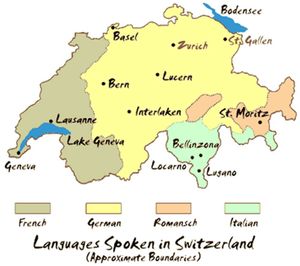
An attractive and unexamined alternative has always stared us in the face in Switzerland, and to a lesser extent in India – both sovereign nation-states that allow and even promote regionally based cultures (down to their own languages) with little or no agitation for fragmentation. If we cannot re-establish the popular American mono-culture, is it at least possible for America to examine a version of the Swiss model? And to also approach such notions without state sanctioned vilification, vitriol, and accusations that such are the efforts of people who are racial supremacists and hate mongers who dismiss the value of other cultures.
But none of these nation saving stratagems can even be examined in a public forum unless and until we can openly ask the unasked question, ‘Can I live, work, and raise my children among people who are like me?’
[24oct10 update] The question of being allowed to live free ‘with your own kind’ is perhaps the most condensed and clear statement of what motivates social behavior in the world today. The dominant propositions here are –
1. A considerable level of cultural cohesion is required if a group of people is to live in peace and prosper within a geographical region.
2. Synthesized cultures based on political ideologies and implemented by the state’s power of the bayonet have been an unmitigated disaster for people swept into such social regimens.
3. In order to not fragment (e.g. as the US in 1860 and the USSR and Yugoslavia in 1991), a sovereign nation-state should permit and support culturally cohesive communities within its borders (e.g. as in Switzerland) when due to, say, immigration, the previously common culture no longer serves.
4. None of the above have anything to do with inter-cultural intolerance or relative valuations.
Predictably, the progressives of the far left have a pat answer – NO! All citizens should be coerced through economic and physical sanctions into the one-size-fits-all state approved culture. And people who even dare to ask about alternative solutions are identified as pariahs, and the discussion subject is changed to the nature and magnitude of the pariah’s deviancy from politically correct norms. (If the deviancy needs to be dressed up to make a stronger case, then the deviant’s ‘real meanings’, along with appropriately modified quotes, are fashioned on the spot and become the focus of the progressives’ righteous reprisal. The evidence for this is ample enough in these pages.)


 rebanesruminations.com
Leave a comment