

George Rebane
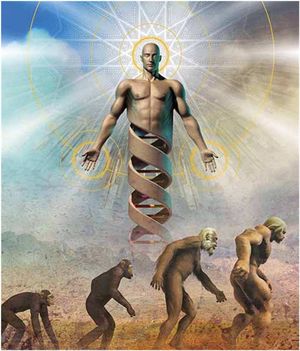 It is a puzzle to me why the secular humanists, who will accept nothing but evolution in its classical or neo-Darwinian sense, are so afraid of the Intelligent Design (ID) theory of the cosmos and especially life on earth. In the latest issue of New Scientist (here) their fear manifests itself in the insistence that ID is nothing less than code for Creationism. And that is clearly wrong as we’ll see below.
I don’t think that the evolutionists are stupid in that they can’t comprehend the difference between ID and the Creationists, those who advocate the long-bearded ‘spot creation’ of the universe in some sense of the Judeo-Christian Bible. The evolutionists must harbor a real fear that if ID is taught in schools as a competing theory to evolution, then it will let the ‘god camel’ get its nose under society’s tent – and then the Bible thumpers will triumph and science will go to hell in a handcart.
Not to worry. Let’s take a quick look at what separates evolution from ID.
Evolutionists believe that our universe began with the Big Bang and everything else after that happened with the probabilistic combinatorics that underpins the fundamentals of Darwin’s theory of evolution through natural selection and mutation – survival of the fittest and all that. The evolutionists are not clear on the causal basis for the Big Bang, and continue with attempts to explain away the necessity for cosmic intelligence through theories like the multiverse that again was most recently argued by physicists Hawking and Mlodinow (here).
Proponents of intelligent design accept the full power and glory of evolution but present arguments rooted in some pretty hard science that, what we see in the fundamental structure of our universe and, especially, in the basis for life on earth, cannot be supported by what they term as the available “probabilistic resources” that our 13.7 billion year-old universe has had to offer. In other words, by about a hundred orders of magnitude there hasn’t been enough time available for matter and energy to clang together randomly so as to create the exquisitely complex structures and processes that reproductive life displays.
The ID solution to this dearth of probabilistic resources is the involvement of an intelligent designer who has the power to selectively meddle with the probability distributions that mediate the productive combinatorics which have yielded what we see. In other words the designer stepped in and helped the universe get over some difficult probabilistic speed bumps on the road to its present state. Behe and Meyer have written very readable apologies for ID.
So ID answers the origin of the Big Bang (and/or the multiverse option), and goes on to give a satisfying ontology and teleology for how we got to this complex state of affairs that we witness daily. But such a theory is highly unsatisfying for pure ideological reasons to the secular humanist evolutionists who cannot countenance a cosmic intelligence. Such resistance is odd in the face of the current status of human knowledge. As a species we can already conceive of the science needed to create a subordinate universe with sentient and sapient critters, a universe over which we would then be the cosmic intelligence and intelligent designer.
Therefore, if we can (now at least conceptually) create subordinate universes, why is not the straightforward answer to this universe’s causal conundra the positing of a similar cosmic intelligence and creative designer to which we owe our existence? Most certainly in its simplicity ID satisfies both Occam and falsifiability better than the alternatives evolutionists are continuing to cobble together year after year. To get past the exquisitely tuned design of this universe, the multiverse theory is a Rube Goldberg approach that would spin Occam in his grave. And since it cannot even make a claim to falsifiability, a multiverse has yet to climb onto the pedestal of accepted science.
Yet ID can be falsified by discovering a prime cause that answers physicist John Wheeler’s last question, “Why Existence?”


 rebanesruminations.com
Leave a comment