

George Rebane
On Friday morning (15 October 2010) the Babenhausen Veterans and Friends were welcomed by Babenhausen’s mayor (Burgermeisterin Gabriele Coutandin) into its city council chambers specially configured for the long-planned ceremony. Twelve of us former/retired Army officers along with our wives had returned to the duty station where we all served in the early 1960s. Our artillery unit was based in the Kaserne (military compound) just outside of town. Over the years this forward base housed ‘STRAC’ artillery units (two hours from combat, 24/7) whose mission was to plug the Fulda Gap about an hour or so to the northeast.
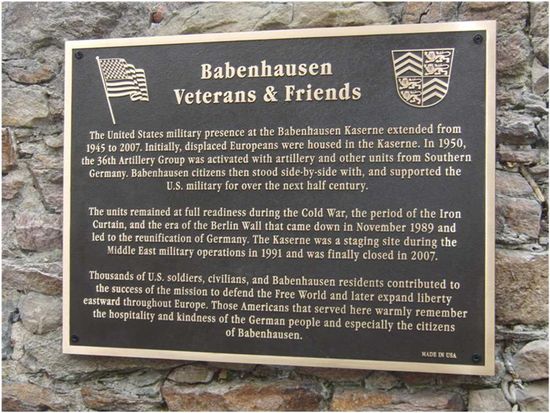
The main Kaserne facilities were built in 1901 on the site of a historical military base that goes back to the 18th century. One of the things we found out on this trip was that Babenhausen (which is in Hessen) was the home of the Hessians that Britain used in our Revolutionary War. And it was these same Hessians that General Washington crossed the Delaware River to rout on Christmas Eve 1776 and thereby change the course of the war which until then had been going poorly for the Americans.
The local count in the area that included Babenhausen ran into money problems with a noble lady he was pursuing in the 1770s. He had this finely trained regiment of Hessians at Babenhausen which appeared to have some value to King George III of England. (Recall that old George was really a German and that the court language of England in those days was German. English had yet to become a language of culture and learning in Europe. Everyone who was anybody spoke and corresponded in either French, German, or Latin with their equally uppity peers.) Anyway, the good count dropped a note to the King and a deal was made wherein the Hessian unit was literally ‘sold’ to England, which then shipped them off to fight its unpopular war du jour in America.
During the ensuing years the Kaserne housed cavalry and artillery units. The huge clear area to the south of the base was ideal for practicing all kinds of maneuvers and shooting skills. Our battalion (2nd Battalion, 5th Artillery or 2/5 for short) put to use the same real estate for the same purposes (except for live firing). In the 20th century the base served as a training area for the Kaiser’s troops fighting in WW1. It subsequently was converted into a police school between the wars, and during WW2 the Third Reich made it into a development base for some of their secret weapons.
The Americans bombed the base twice during WW2 and a few stray bombs hit the town, one of which destroyed the Rathaus (city hall) in the middle of downtown. Our combat units arrived in April 1945, about a month before the war ended. This began a stay which ended when we left in 2007. In the last years of the American presence, Babenhausen Kaserne was used as a staging base for Gulf1 and Gulf2.
(As can be seen from the text on the plaque, the kaserne also housed war refugees immediately after the war. These were primarily Estonians, Latvians, and Lithuanians. What happened to an unknown number of these refugees after the war is a dark chapter in the history of this military base. I will have more to say about it in another installment of my own story.)
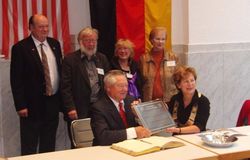
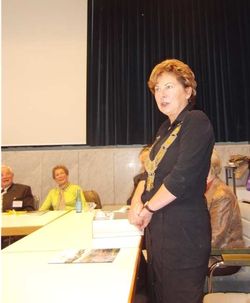 So there we were in our suit coats and ties (yours truly doesn’t wear one anymore) listening to her honor welcome us and extol the years of good relations between our two nations as we stared down successive Soviet leaders who eyed the riches of western Europe as their own communist economy was tubing. After all the speeches there was an exchange of presents. The mayor invited all the veterans and their wives to sign Babenhausen’s ‘Golden Book’ – a hoary looking bound volume that has recorded the signatures of the town’s important visitors and honored guests. We felt equally honored being asked to add our john henries. (Below, the mayor with Walter Duke signing book.)
After the doings in the council chambers, we retired to a local restaurant for another round of serious cholesterol. In Germany the definitive cultural dictum is ‘when in doubt or not, eat!’, and we ate. From the pictures you can see that these former cannon cockers were not lacking for girth, but it would have been impolite to refuse one more round of schnitzel and brat kartoffeln. Besides, what’s another ten pounds? We’ll work it off when we get home – right.
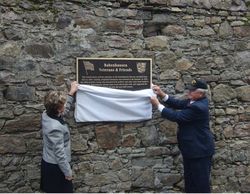
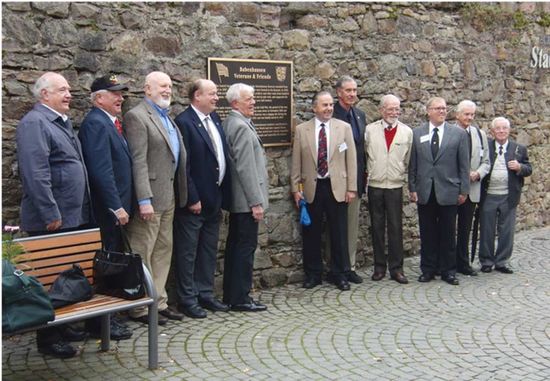
 After lunch the whole gathering repaired to a certain section of the old (13th century) city wall that has been reserved for fastening all kinds of important memorabilia. Our plaque, with its proud ‘Made in USA’ at the bottom, was unveiled by the Mayor and Walter Duke. Walter is the former commander of 2/5’s air section, and the hard-working cat herder of our veterans and friends group that now numbers almost three hundred officers and senior non-commissioned officers. When the plaque was bared for all to see, taking the interminable series of group photographs started. Her honor, an important constituent of almost each one of them, bore up remarkably well with a smile that lasted the whole session. (The well-fed old guys surrounding the plaque are the attending former 2/5 officers who looked much better in the 1960s.)
 More eating and drinking went on that night with another big dinner that included past Babenhausen dignitaries, but by now, you knew that. Finally, we said many thank yous and good nights, and everyone was relieved that Babenhausen had survived the latest entry into its long and fabled history. The following day our eaters anonymous group took their act to an unusually picturesque town called Erbach, about thirty minutes to the south. There we spent the day in museums and cobblestoned streets lined with shops most all of which were closed because it was Saturday.
With little fear of contradiction, I opined that Germany could increase its GDP by at least 15% any time it wanted by simply doing away with their silly regulations limiting retail selling on weekends. The head chef of Erbach’s leading restaurant (where else did you think we would be?) agreed that that would be the case, and added that within about five years those laws would be off the books – Germany needs the money.
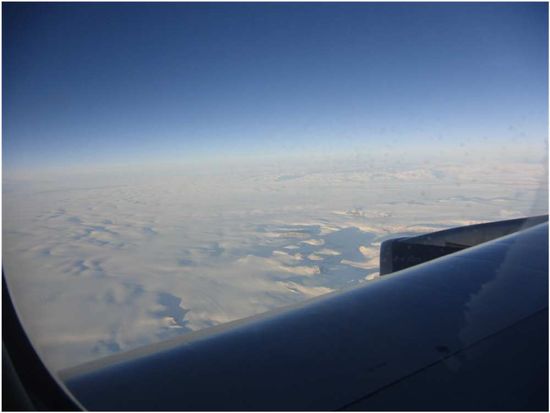
And so ended our remembrance of the times that shaped all of our lives almost fifty years ago in that small town and its celebrated kaserne. The next morning (Sunday) Jo Ann and I said our own goodbyes and drove to the Frankfurt airport for the hop to London, and the skip over the Arctic back to San Francisco (see awesome scenery of northern Greenland). That night we were happy to be back again in the land of the round doorknobs.


 rebanesruminations.com
Leave a comment