

George Rebane
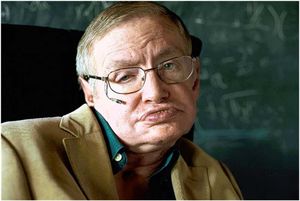 From multiple sources we hear that The Grand Design, the latest offering from Professors Stephen Hawking and Leonard Mlodinow, will appear a few days from now on 7 September 2010. This is an essay on their most current theory of the cosmos – we recall that cosmology is science in the large about all existence. The punch line of their findings is that they have finally cracked the code on ‘Why God Did Not Create the Universe’. In the 4sep10 WSJ article of the same name, the noted scientists co-author an explanation for the rest of us as to why their main thesis must be true.
Seeing the title, I got all excited as I usually do whenever the most recent and definitive attempt to usher God out of the picture is advertised. Maybe this time they’ll finally go beyond the next step in ‘Sonny, it’s turtles all the way down!’ Sadly, I was disappointed. In their latest effort, Hawking and Mlodinow take another turn around the same old barn, joining the many similarly motivated scientists all of whom continue to add another lap to this irresolvable race to evict any form of an overarching intelligent designer in the cosmos. Some time ago I gave an accounting (‘Multiverses All the Way Down’) of this perennial effort in which the reader new to the cosmology circus will also find the ‘turtles all the way down’ story.
Nevertheless, Hawking is one of my heroes (my definition, not the media’s), and I will read the book just to make sure I’m not speaking out of the wrong end on this latest attempt. Before I continue, let’s take a look at the conclusion of their WSJ piece where they triumphantly serve their eviction notice.
As a preamble, they first review the very low likelihood for all our laws of physics and the values of the universal physical constants to be just so, that when they combine, we see familiar stuff happen. When you run the numbers on what alternative laws and values could have occurred, you come up with the odds of our universe happening to be somewhere between slim and none – and I mean VERY slim. To a lot of people this does seem like ‘gosh are we lucky’, especially when you throw in the whole bit about adding ‘life’ to the mix.
Lucky schmucky. The answer to winning the cosmological lottery was a simple one – just posit that the cosmos contains a gazillion universes all popping into and out of existence, and voila! one of them was bound to pop up with the proper laws and constants. And here we are, no need for a God to create this very special ‘low probability event’ that we call our own universe. All we had to add now was some real neat mathematics to go with some even neater physics, and we can all keep a straight face when next we bravely describe the ‘multiverse’ of a gazillion universes. And that is what apparently the good professors Hawking and Mlodinow have claimed. In their own words –
Many people would like us to use these coincidences as evidence of the work of God. … That is not the answer of modern science. As recent advances in cosmology suggest, the laws of gravity and quantum theory allow universes to appear spontaneously from nothing. Spontaneous creation is the reason there is something rather than nothing, why the universe exists, why we exist. It is not necessary to invoke God to light the blue touch paper and set the universe going.
Our universe seems to be one of many, each with different laws. That multiverse idea is not a notion invented to account for the miracle of fine tuning. It is a consequence predicted by many theories in modern cosmology. If it is true it reduces the strong anthropic principle to the weak one, putting the fine tunings of physical law on the same footing as the environmental factors, for it means that our cosmic habitat—now the entire observable universe—is just one of many.
Each universe has many possible histories and many possible states. Only a very few would allow creatures like us to exist. Although we are puny and insignificant on the scale of the cosmos, this makes us in a sense the lords of creation.
But ‘inventing’ or ‘predicting’ the multiverse does not get us out of climbing down the stack of turtles. The technical reader immediately recognizes that none of the multiverse theories are testable. That is why they still await entry on the threshold of science along with older ones like string or M-theory. Recall, the two pillars on which any scientific proposition must rest – Occam’s razor and falsifiability. The multiverse approach may be simple only in relation to God (oops) knows what more complicated Rube Goldberg contraptions can come out of the mind of man – anybody remember epicycles?
But let’s skip over the more tenuous Occam, and posit that this is the simplest explanation for those pesky observables that every qualifying theory must explain. The high hard one is still falsifiability. If someone claims a proposition (here the existence of a gazillion universes) is scientific, they need to answer, not only what testable answers can it give to new questions, but what testable wrong answers will prove the proposition false. No one has yet a clue on how to poke our ‘head’ out of this universe and rummage around another one to see if it exists and what is there.
For the diehard secular humanist, let’s be kind and not even quibble about Occam and falsifiabilty. Let’s bravely posit that the multiverse of Hawking and Mlodinow exists, even if we can’t ‘see’ it. OK? Let’s just say it’s there, full of all gazillion of them. At this point, should we not pay attention to a voice, way up high in the back row, that quietly asks ‘But professor, in or on what does the multiverse rest?’ ‘Oh no you don’t, you young whippersnapper …!!’
[11sep2010 update] In today’s WSJ Sean Carrol does his best not to be impolite to the distinguished Hawking and Mlodinow in his review of their just released The Grand Design. Carrol’s points and the points in the letters to the editor circle tightly the points made above and in the comment thread below.
The overall discussion would benefit from a defined ontology that includes notions like ‘existence’, ‘cosmos’, ‘universe’, ‘intelligent designer’, etc, and, perhaps, adds ideas such as aseity. I will offer such an ontology in a future post, and after I read the book.
That Hawking and Mlodinow assert that “… philosophy is dead” displays more than a bit of hubris since their arguments cite and raise new issues of a strictly philosophical nature. The hubris is expanded in their omission of the clear limits to human cognition in that we cannot think all thoughts. This has been extravagantly demonstrated by the scientific expansion that the last century witnessed, and that this century promises in abundance.
At this time in the intellectual development of Man, to put up limits and erect walls that say ‘there is nothing beyond here’ is to me foolish. At best we can only haphazardly guess that it may be more fruitful to now explore here and not yet there. And we have even erred in these choices as demonstrated by the lives of such loners as Kepler, Newton, Einstein, … .
[18sep2010 update] Got my copy of The Grand Design last week and read it immediately. It’s a fascinating read and highly recommended. My review of its content and arguments are found in ‘God Gets to Stay’.


 rebanesruminations.com
Leave a comment