

George Rebane
The self-serving liars in Washington have attempted for the last two years to convince us that they have injected newly printed and borrowed cash into our economy in order to stimulate it out of the recession that followed the housing bubble. This has not come to pass. The economy has struggled to find its feet in spite of the imposed government impediments to weigh it down.
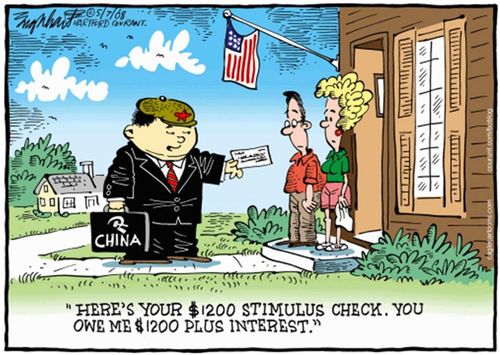
In this interval we have executed a Keynesian folly that still portends our economic demise. Long time RR readers know that I am of the Austrian school persuasion bathed in the evidence of its general correctness describing and predicting the predilections of humanity’s fisc.
The Mercatus Center at George Mason University offers an illumination (here) of the much propagandized stimulations from our nation’s capital, stimulations that have turned out to be a bland prophylactic to what is really needed. Ludwig von Mises prescribed the correct emetic to purge our system of what ails us – “Do nothing, sooner!”
[update] Maybe what we now need is more of what a Democratic Congress gave us in 1945 after the war had ended. FDR and his New Deal had miserably extended the Great Depression through the thirties, and WW2 had been an unsustainable bump in employment that was now going to result in greater layoffs than ever before. As reported by the Folsoms of Hillsdale College in the 12apr10 WSJ (here), Truman advised Congress to resume FDR’s alphabet soup socialism, but Congress “responded by just saying ‘no’.” And it was a pretty comprehensive NO.
No to the whole New Deal revival: no federal program for health care, no full-employment act, only limited federal housing, and no increase in minimum wage or Social Security benefits.
Congress cut taxes instead, and in doing so almost eliminated the short post-war recession and gave rise to what today we call supply side economics. Apparently more than one member in that august body had become aware of F. Hayek’s The Road to Serfdom which came out in 1944. Then with lowered taxes, the economy exploded and kept expanding for the next twenty years.
By the late 1940s, a revived economy was generating more annual federal revenue than the U.S. had received during the war years, when tax rates were higher. Price controls from the war were also eliminated by the end of 1946. The U.S. began running budget surpluses.
Congress substituted the tonic of freedom for FDR’s New Deal revival and the American economy recovered well. Unemployment, which had been in double digits throughout the 1930s, was only 3.9% in 1946 and, except for a couple of short recessions, remained in that range for the next decade.
The Great Depression was over, no thanks to FDR. Yet the myth of his New Deal lives on. With the current effort by President Obama to emulate some of FDR’s programs to get us out of the recent deep recession, this myth should be laid to rest.


 rebanesruminations.com


Leave a comment