
George Rebane
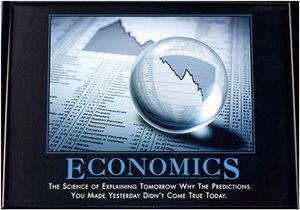 RR readers are familiar with the two pillars on which science stands – Occam’s razor and falsifiability. I have for years railed against the economics on which know-nothing public policy makers rely. Almost all of them are innocent of any training in math-science, and most of them are innumerate to boot. The gaps in their education and knowledge are firmly patched with hubris, and the belief that we are dumber than they are.
After Dr Russ Roberts wrote his 27feb10 WSJ piece, I started unlimbering my pen for a dissertation on reinforcing Roberts’ points and filling in some gaps he left. This morning’s WSJ contained a letter from a reader, Theodore A. Gebhard, that covers almost everything I wanted to say, and covers it well. The only notion I want to re-emphasize from past RR postings is that it is the collectivist economists (e.g. Paul Krugman of Princeton) and their political funders who continue to believe and convince us that their mathematical models are science which should inform new public policies and how we organize our governance. In this, these people are worse than the scam artists in climate science who claim verity in their general circulation models and have now made that ‘science’ a fraudulent enterprise. But I digress.
The sequel contains Mr/Dr? Gebhard’s letter in its entirety, and I throw in one from Mr Roy Carriker for good measure. Enjoy.
===
Russ Roberts is spot on in questioning whether economics can legitimately be called a science (“Is the Dismal Science Really a Science?,” op-ed, Feb. 27). The great 20th-century philosopher of science, Karl Popper, famously defined a scientific question as one that can be framed as a falsifiable hypothesis. Economics cannot satisfy that criterion. No matter the mathematical rigor and internal logic of any theoretical proposition in economics, empirically testing it by means of econometrics necessarily requires that the regression equations contain stochastic elements to account for the complexity that characterizes the real-world economy. Specifically, the stochastic component accounts for all of the innumerable unknown and unmeasurable factors that cannot be precisely identified but nonetheless influence the economic variable being studied or forecasted.
What this means is that economists need never concede that a theory is wrong when their predictions fail to materialize.
A further consequence of the inability to falsify an economic theory is that economics orthodoxy is likely to survive indefinitely, irrespective of its inability to generate reliable predictions on a consistent basis. As Thomas Kuhn observed, scientific orthodoxy periodically undergoes revolutionary change whenever a critical mass of real world phenomena can no longer be explained by that orthodoxy.
It is clear, however, that, because economists never have to admit error in their pet theories, economics is not subject to a Kuhnian revolution.
The problem is that the cachet of a Nobel Prize in Economic Science and the illusion of scientific method permit practitioners to market their pet ideological values as the product of science, and to insert themselves into policy making as expert advisers. Econometric modeling is no longer chiefly confined to generating macroeconomic forecasts. Increasingly, econometric forecasts are used as inputs into microeconomic policy making affecting specific markets or groups, and even are introduced as evidence in courtrooms where specific individual litigants have much at stake. However, most policy makers—let alone judges, lawyers and other lay consumers of those forecasts—are not well-equipped to evaluate their reliability or to assign appropriate weight to them.
Mr. Roberts sums it up well when he states that economic theories can be powerful tools for organizing one’s thinking. But as Friedrich Hayek taught us, good economics can say a lot about tendencies among economic variables (an important achievement), but not much more. By contrast, the naive pursuit of precision by means of econometric modeling, especially as applied to public policy, is fraught with danger and can only deepen well-deserved public skepticism about economists and economics.
Theodore A. Gebhard
Washington
===
While economists have attempted to treat economics as a science and discover its “laws,” the invisible hand they seek doesn’t exist. Massive as the efforts over decades have been to achieve scientific predictability through theories and modeling, economics continues to lack this capacity.
Capitalism includes the interdependent actions of not only markets, capital and labor, but also politics, geopolitics, technology and human behavior. With such a dynamic miscellany, the folly of reducing economics to a science is easily understood.
This is not to say that economics is not a highly useful discipline; it just is not a science. History too is a very valuable discipline from which we learn and can project possible future outcomes, yet the outcomes are not predictable via some “law” of history. Witness how history was irreversibly changed by the steam engine, Hitler, the A-bomb, semiconductors, etc.
Roy Carriker
Philadelphia

 rebanesruminations.com
Leave a comment