Rebane's Ruminations
February 2010
S M T W T F S
 123456
78910111213
14151617181920
21222324252627
28  

ARCHIVES


OUR LINKS


YubaNet
White House Blog
Watts Up With That?
The Union
Sierra Thread
RL “Bob” Crabb
Barry Pruett Blog

George Rebane

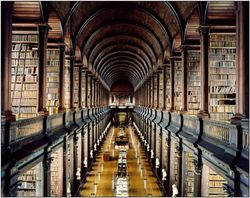
Library The future (and past) of libraries is the subject of Marilyn Johnson’s This Book is Overdue.  I have just read a WSJ review of the book by Christine Rosen (‘From Wisdom to Wi-Fi’).  Johnson covers a lot of ground in the book about libraries and, interesting for this day and age, librarians.  The latter are represented as not the staid, visually impaired, prudish ladies that is their stereotype.  Even their job title seems to be undergoing some renovation and hopes to emerge as “information scientist”.

But the more interesting part that libraries are shedding their research departments and seeing themselves morphing into “a place where parents and toddlers might want to pick up a DVD and a latte.”  Research departments are being “jettisoned” because they actually employ people with some skills beyond a good Barnes&Noble clerk, and the mistaken notion that everything today is on the internet.  Maybe it will be tomorrow or the day after, but not yet.

So we are at a crossroads that each community has to negotiate on its own.  That is, unless your library gets its funding from a higher source, in which case they’ll make the decision for you.  Here in Nevada County we have been going through some pretty serious soul searching on how to go forward with a greatly reduced budget for our county library system.  It looks like our Supes will not hire out library operations to a private company.  The community is stepping up with a lot of alternative ways to keep it open using volunteers and public contributions.  There is something basically good in that approach – it’s our library, and we’ll keep it open with the wherewithal that we can muster locally, instead hoping the folks in Ohio will chip in.

But there’s more to libraries than possibly becoming a hybrid Blockbuster, internet café, and latte place.  At least there was more to libraries in the past when people knew how to read.  Rosen’s book report ends with a lament generalizing on the New York Public Library experience wherein she also quotes Google’s Eric Schmidt worrying about the public’s “loss of deep reading skills” as we spend less time with serious writing and concentrate on deciphering short, abbreviated pseudo-sentences on our monitors and mobile devices.

Nowhere is this loss of deep reading skills more apparent than in the comment threads attached to online articles and blog posts.  Pick any such website and examine the heat-to-light ratio of the comments.  Almost all of the heat is generated by commenters whose skills range from ‘not a clue’ to ‘what is a subjunctive?’, and forget about using counterfactuals if you want your scribbling understood.  Which brings up the question – if not in an old-fashioned library with real literature, where do we go to learn how to dissect ideas the complexity of which matches that of our world?

Online ebooks is not yet an answer, because just because it is available online doesn’t mean that I know to access it.  Someone/thing with enough smarts has to be available to identify and integrate my deficit and need, and then be able to direct me to the volume(s) that will serve.  Today that is a learned human, and for most of us that human still happens to be a librarian.

Posted in , , ,

3 responses to “The Library – Another Fundamental Transformation”

  1. Mikey McD Avatar

    George, a serious debate is needed to discuss the current and future role of our tax payer funded library system. Should our library system be an internet hub/destination, an ongoing literacy campaign (teaching all ages how to read), research depot, trendy cafe “hot spot” or some combination of the above?
    I understand all undergraduate education to be the equipping of individuals with the ability to find and interpret information from ‘all’ forms (literature, theory, speeches, movies, theater, etc).
    amazon.com is my “library.”

    Like

  2. RL Crabb Avatar

    One of the things I really miss is the lost art of letter-writing. Reading the letters of people of centuries past has always provided a window to the soul of a person, especially since it was a private thing between two intimates and the missives were never seen until long after the writer’s death. These days, you have to be conscious of the possibility that your email may be forwarded all over the net.
    A few years ago I ran across a book called “American Aurora – a democratic republican returns”.
    It’s the story of Benjamin Franklin’s grandson, Benny Bache, who ran a scandalous newspaper in the 1790’s. It’s filled with snipets of letters and newspaper articles during the tumultuous early days of the republic.
    It reminds me a lot of today’s blogs, full of invective, rumor and fierce partisanship. We really haven’t changed very much.

    Like

  3. Russ Avatar

    Another point of view by CETF, which manages a fund for the California PUC to bring broadband to ALL of California:
    Libraries – 21st Century Hubs for Digital Inclusion
    Sunne Wright McPeak, California Emerging Technology Fund
    December 14, 2009
    As renowned California historian and State Librarian Emeritus Kevin Starr has proclaimed, it is time to “reboot California”—literally “restart” all aspects of governance and reform all institutions of government. That includes a transformation of libraries to be 21st Century Hubs for Digital Inclusion—places where the public can use their library card not only to check out a book, but also to access a computer for high-speed navigation of the Internet to retrieve information from the virtual global library.
    While prominent librarians throughout California share this vision and many libraries provide computers for public access, they lack adequate resources and sufficient policy support to make this concept a reality. Often there are too few computers in a library for the demand and, thus, the time allowed for each user is limited. Imagine trying to complete a college application in the allotted 15 or 30 minutes at a time to use a public library computer, but that’s the reality faced by students and families who do not have a computer or broadband service at home.
    Fortunately, State Librarian Stacey Aldrich and the Bill & Melinda Gates Foundation are convening library leaders and stakeholders to plan for 21st Century libraries. The California Emerging Technology Fund, whose mission is to close the Digital Divide in our state, see libraries as key partners to help all Californians get connected. We envision libraries being both physical and virtual centers of knowledge and information—21st Century Hubs for Digital Inclusion—by:
    • Expanding public access to computers, increasing the number of computing devices available for public use inside libraries, including on Native American tribal lands.
    • Providing digital literacy training through professional staff and volunteers, orienting non-users to the basics of using a computer and navigating the Internet.
    • Establishing libraries as broadband (WiFi) hot spots, so that there is wireless access in and around the vicinity of libraries for residents to use their own computing devices to obtain high-speed Internet access.
    We invite all elected officials and policymakers to join this call to action for libraries of the future. Advancing this vision will be a giant step forward for Digital Inclusion and will add to California’s reputation of being a national leader in closing the Digital Divide.
    Sunne Wright McPeak is president and chief executive of the California Emerging Technology Fund, an independent, public-purpose non-profit whose mission is to close the Digital Divide in California. CETF has offices in Los Angeles and the Bay Area.

    Like

Leave a comment