
George Rebane
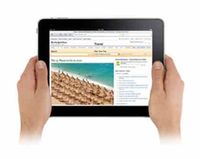 Today Steve Jobs of Apple brought out the long-awaited iPad. It is the gizmo that Apple hopes will become the way we will do most of our information gathering and online communications. Well actually, the iPad does even more as you can read from their brag sheet here.
I have been predicting the demise of the dedicated ereader since Amazon recently introduced its Kindle, and now a bunch of others have jumped into the same frying pan. Today we see that it didn’t take long for the dedicated ereaders to be eclipsed by galloping technology, because the iPad delivers ebooks as just one of the many other things that it also lets you do.
We may think of this as all new stuff, but it really isn’t in the sense that all of the functionality of such gizmos was anticipated and described way back when. When? At least in the seventies when Ted Nelson was talking to everyone about something called Xanadu. He’s the visionary who gave us the words ‘hypertext’ and ‘hypermedia’, and the descriptions of how they would work. Too bad he was a bit eccentric, ahead of his time, and missed out on the big bucks.
But to really give you an idea of how long the exact ideas and early hardware implementation of what is now iPad, I want to point you to a piece – ‘From P-books to E-books’ (Download Press_ebooks2000) – written by Dr Larry Press back in May 2000. Larry is a professor of computer information systems at CalState, and was a columnist covering new ideas and technology for the prestigious ACM Communications. (I get to call him Larry because he and I go way back to 1958 at UCLA when we both belonged to the same house on fraternity row. But that’s another story, most not publishable.) Larry is still in the saddle and even does gigs for corporations and the UN on projects involving networking and the internet. Back then he wrote –
The dream of electronic books has been with us at least since Vannevar Bush published his famous article, “As We May Think,” in which he speculated on a desk-sized machine that would hold one’s personal writing and library [1]. Alan Kay named his prototype of the modern PC the Dynabook, and related research has been done at prestigious centers including Xerox PARC, MIT, Bell Labs, and Brown University. I have speculated about e-books and portable devices earlier (see [6, 7]), but am still reading paper books (p-books) because content is abundant and user interaction is simple and subconscious. The idea of an e-book is appealing – a single device with an entire library of interlinked documents, dictionary lookup, unlimited, sharable annotation, search capability, and so forth. But the technology to date has not been good enough to displace the p-book. Is it now?
The middle of the article contains a very readable description of the hardware and software needs for an ereader, and how the early ereaders stacked up to these requirements. Yes, there actually were ereaders ten years ago with names like ‘Rocket Ebook’ and ‘Softbook’. In any event, it’s an interesting read about the technology of those good old days and a chance to marvel at the distance we have come. (Please fasten seatbelts for the next ten years.) The article concludes with –
The e-book has been long promised and slow to deliver, but it may now be ready to emerge. This will depend upon evolving technology and the quality of design and engineering—the technology will have to enable a transparent device and user interface. As always, human and organizational issues will also constrain what we end up with and when we get it. Adoption will be slower than e-book proponents expect, because there are powerful, conservative social and organizational forces holding back change and the adoption of standards. Yet, in the long run, the impact of the ebook may be greater than envisioned. The e-book will be more than a substitute p-book. What will be the social and psychological impacts on the generations of kids who first meet Spot and Sam on e-books in kindergarten?
Enter the iPad.


 rebanesruminations.com
Leave a comment