

George Rebane
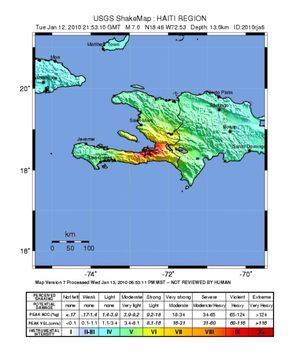 The devastating earthquake on Tuesday (12jan10) that pretty much leveled the Port-au-Prince region of Haiti is almost too big to get my mind around. Thinking about the real size of that disaster must include the world’s response to it, and it promises to be colossal.
Haiti is a country that by all objective measures is pretty much worthless to anyone not living there, and worth very little to those so burdened. This conclusion is supported by any number of references about the country. It has no natural resources that anyone wants, what used to be the natural beauty of Hispaniola has been decimated by its people (you can make out its boundary with the Dominican Republic from space), its governments are sequentially dysfunctional, its economy is on permanent international dole, and the people are a grim lot – mostly destitute, desperate, and uneducated. Its major export consists of contraband humans on makeshift ‘boats’ risking shark-infested waters to seek a better life elsewhere – mainly in the United States.
And now a world-scale disaster has struck that has left tens of thousands dead, and most certainly, countless more dying under the rubble even as I write. Yet the world is rushing help of all kinds to that little cesspool of a nation. Planeloads of supplies land on its single runway ‘international’ airport, and ships of all descriptions are being dispatched with aid to a seaport no longer able to receive them. In thousands of homes across the world people are writing checks and sending them to various relief agencies.
For years I have puzzled about the effect of the self-soothing aid we send to the less developed people of this planet. As some RR readers may be aware, I have come down heavily on the side of arguments pointing out the harm our so-called aid has done to keep the poor regions perpetually poor.
And then a dear friend up and went to Haiti a couple of years ago and started an orphanage (here). Of all places, Haiti! The pictures and stories from that effort washed away the aggregate statistics that characterized the country; now we were looking at real kids with real faces looking back at us. They opened our hearts and we opened our wallet.
None of that affected the broader calculations that had consigned Haiti to the ‘do not resuscitate’ category. It was human emotion, pure and simple. I have no idea how those kids will grow up and what they will do to or in the world. Right then and there they were kids in need, and our friend was building them an orphanage. What were we supposed to do, read him a page from Easterly’s White Man’s Burden? (see also ‘The Catastrophe of Compassionate Charities’)
But all those neat conclusions seem to recede into the background when death arrives wholesale. And so they died, leaving millions now living in pain that comes from more directions than we can count. Undeniably, it affects all of us when a tsunami washes away a quarter million people, or a flooding river in China claims millions, or when we had fifty thousand people die within one minute or so last Tuesday. I guess life loves life, and demands to fight back when it sees death at such scale.
Perhaps these mega-tragedies are God’s way of giving each of us an opportunity to recalibrate and reflect the good side of our humanity. Too infrequently, we are guided by Jesus – ‘Whatever you did even unto one of the least of these, you did unto me.’ Go write a check.


 rebanesruminations.com
Leave a comment