

George Rebane
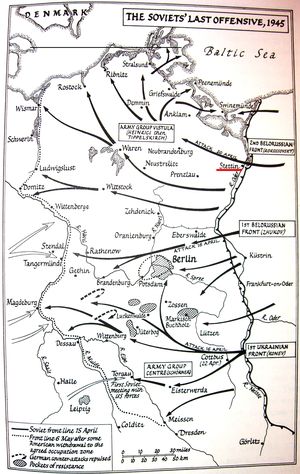 Sixty-five years ago we celebrated Christmas 1944 in a small uninsulated cabin the Germans called a Behelfsheim, a ‘temporary accommodation’. The Third Reich built these to house the tide of refugees fleeing the Red Army then rapidly advancing from the east. Our cabin was in a long row of such cabins next to a large empty lot (it seemed like a field to me) near the edge of Stettin. I remember a howling snowstorm outside was trying to force its way in through the thin walls. That Christmas we had a little green bush with lit candles on the table but no presents.
My great-aunt Alvi (Alvina) had come to visit with some small hard-to-get delectable that we had shared for the Christmas Eve meal, and then we huddled around the wood stove to hear Herr Goebbels’ evening radio talk to the nation. Every night he informed us of the great victories the Germans were winning. After the war my father told me that the German propaganda minister was not fooling anyone because the victories were constantly being won closer to Germany.
Leading up to this Christmas the big news had come from the west. The Germans had launched a major offensive designed to stop the Allies advance in France and set up conditions for a negotiated peace – or so everyone thought. History would lump all these battles together as the Battle of the Bulge, and recognize it as a speed bump on the march to the Rhine. Nevertheless, it was the season of hope and all of Germany was hoping that the terrible five-year war would soon be over.
My mom, dad, and I had arrived in Stettin the previous spring. We were part of the growing wave of east Europeans fleeing the Red Army as it began its final offensive on Nazi Germany. Our native country of Estonia had fallen to the Soviets that September, and it later turned out that almost one hundred thousand or 10% of the population had fled. Those who stayed believed that after the war the Red Army would quietly go back across the USSR border and Estonia would again be free.
My father was an electrician who had started a small appliance repair shop in Estonia’s capital Tallinn. He and others like him were considered enemies of the people by the communists. Under Soviet rule in 1940 our family was one of many targeted for either execution or the Gulag. During one infamous night in June of that year, the NKVD (precursor of the KGB) arrested over sixty thousand Estonians and herded them into waiting cattle cars that took them into the Siberian Gulag. My uncle Leo and other more distant family members were among those who took that one way trip. My parents and I spent six months of my first year living in a camouflaged hole in the forest near my paternal grandparents’ farm while the communist partisan patrols combed the countryside. For those who stayed, all of this would soon be repeated.
But as the Red Army again approached in 1944, aunt Alvi left Estonia first and then advised other Rebanes to follow her. Only my father took her advice. We packed everything important into such suitcases as my parents could carry, and boarded a wartime train of refugees and wounded down the Baltic coast to Stettin on the Oder River. Aunt Alvi was already there in a small apartment and had gotten a job from the war ministry sewing chevrons and epaulettes for German uniforms. Upon arrival we all squeezed into her apartment until my father figured out what to do to feed and house us.
I recall a very colorful and green spring, and a mood in the air that was totally different from the war we had left behind in Estonia. There Tallinn was in range of the Soviet bombers which had already started terror bombing the city’s residential areas. The Americans and British would adopt that strategy in late 1944. Many of my early memories were of nights in the basement of our apartment house as the world literally came apart around us. This was in the days before counseling for post traumatic stress disorder was available – just suck it up and get ready for it again tonight. But Stettin during that spring gave almost the feeling of peacetime, except, of course, for all the uniforms and military vehicles on their way to the eastern front.
My father got us papers as registered Baltic refugees, and because he was an electrician, he was assigned to a civilian work battalion. My dad thought that because he had a valuable skill, we got to live in that little Behelfsheim cabin consisting of two rooms – mainroom/kitchen/eating plus an even smaller bedroom. There was electricity and running water, but no bathroom. We washed everything in the one sink and emptied the chamber pot into an open five-by-five foot hole in the middle of the ‘field’ across the street. That was one of my jobs.
That summer I joined the other kids my age on the nearby streets and became fluent in four-year-old German. All of us kids took care of ourselves in those days. To be rated for unsupervised neighborhood play, all you had to know was where you lived and be ambulatory. But things began to change as summer settled in. In June we learned that the Allies had landed someplace called Normandy but would soon be pushed back into the sea. They weren’t, and not long afterward Stettin began being targeted by both the Soviets and the Eighth Air Force as a railhead, port, and major river crossing. Escorted by P-51s from France, B-17s and 24s from England could now penetrate deep into Germany.
The Soviets would hit the city almost every night at 8PM, just before dark. The Americans came anytime during the day but less frequently. When we heard the sirens, all of us kids would just run back home. Nobody panicked, we knew the drill. For the evening raids the sky would light up with dozens of searchlights, and the anti-aircraft batteries would fill the air with their sound and fury. Every once in a while a bomber would be hit and explode or come screaming down in a flaming trail.
During these air raids the Behelfsheim residents would pile into bomb shelters that were little more than shallow holes in the ground with a wooden door located within fifty feet of the cabins. There would be one bomb shelter for two or three cabins. Everyone arrived with a bag or small suitcase or two containing important things like family pictures, documents, jewelry – stuff that connected you to your past and that you had to have to survive the war. By 1944 my parents were experts at quickly packing our remaining ‘treasures’ into fewer and smaller suitcases.
The bombs would mostly fall about a mile or so from us, and on hot evenings the men would keep the wooden door open for air and we all saw the ‘show’. But when nearby neighborhoods got hit, the earth shook and things were flying through the air. Then the doors stayed closed, we never knew if the next ‘stick’ of bombs would hit us. Things changed in the fall as the weather got colder. Then we sometimes shivered all night in those holes. We actually liked the rainy weather because that meant less chance of another air raid and we could sleep inside. Rain or shine, my father had to go to work every morning to put electricity back into the growing ruin and rubble of Stettin.
Now it was finally Christmas and things were not looking up. My parents knew that there would be no negotiated peace, that the Red Army would roll right up to the Oder River and Stettin, and that it would just keep rolling on to Berlin that was only about sixty miles to our south west (click on map). As an almost five-year-old, I already knew what ‘captured’ meant and had been carefully taught the Estonian historical view of the Russians.
On that Christmas Eve my parents and aunt Alvi talked about how we all could get out of Stettin, and head toward the south and west of Germany. There we knew the Americans would come. Staying in Stettin was sure death, for now the Soviets considered us also as traitors for having fled from the new Soviet Estonia to aid the hated Germans.
But in those days no one traveled in Germany without specific government permission. And the reports of atrocities, as the Red Army swept through Prussia and Poland, were beyond belief (see Max Hastings’ Armageddon, Chapter Ten). With every passing day, space on the remaining trains was becoming a critical commodity. We knew that foreign refugees would now be last on the travel pass list and also suspect – the Gestapo was on the lookout for saboteurs, deserters, and shirkers, Hitler brooked no retreat from his army or his people.
Even though things were again serious for our family, listening to the talk of another train trip did make me look forward in anticipation. Little did my parents know that on this Christmas Eve they were planning the train rides of our lives which were yet to come in April 1945.
[Historical note. After the war Poland was ‘moved’ westward by the Allies. The USSR simply annexed a part of east Poland into the USSR, and Germany was forced to cede all its eastern part up to the Oder River to the Poles. Germany also lost all of East Prussia to the Soviets and Poland. Stettin then became a Polish city and was renamed Szczecin, by which name it is shown today on the German-Polish border.]


 rebanesruminations.com
Leave a comment