

George Rebane
“It ain’t what you don’t know that worries me, it’s what you know that ain’t so.” Will Rogers
We are often taught that parties can always settle their differences by engaging in a reasoned dialogue – ‘Come, let us reason together.’ But the evidence, today available in thousands of comment threads on more thousands of blogs and online media outlets, seems to contradict such hopeful paths to resolution. Self-referentially I can say that there is no reasonable basis for such a conclusion. It’s the word ‘always’ that becomes the bugaboo, and gives lie to the frequent goal and noble sentiment. Fisher and Ury of the Harvard Negotiation Project acknowledged this failure in their landmark essay Getting to Yes (1981).
Recently this point was driven home by Mr. Steven Frisch, a RR reader and commenter of the liberal persuasion. He posted two magnificent and voluminous ripostes (here and here) wherein he seeks to destroy my motive and method for the offered commentaries. As I studied his comments in preparation for a reply, it became clear that his presumably reasoned compositions belonged to a class that was inaccessible to me (and perhaps others). To contend with his assertions and accusations on a point-by-point basis would be a fruitless effort. From my perch, his reasoning was insane and would give no purchase for me to attempt a reply. Let me explain.
For some time I have wanted to put forth a structured and accessible explanation of why reason fails in the daily round of good-hearted, well-meaning men and women. The following will be a bit technical, but guaranteed to contain not a hint of a squiggly (aka formula) or a drop of math. But it will help to keep one eye peeled on my little hand-drawn graphic below that represents a very general reasoning paradigm.
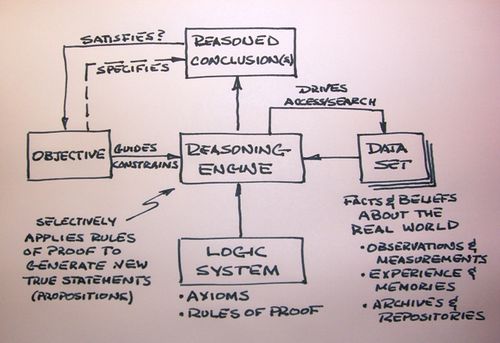
Let’s start with the high hard ones. Looking at the figure we see a Reasoned Conclusion that is the output of a Reasoning Engine that resides on top of a System of Logic which provides the main input and support for the Reasoning Engine. This engine also gets inputs from the Objective module and one or more pertinent Data Sets. Now look in turn at each of these boxes and their connecting arrows (inputs/influences).
System of Logic. A logic is made up of a set of axioms and related rules of proof. Axioms are statements (propositions) which are taken at face value to be true; that is, they require no further proof – say, ‘the sun shines’. Rules of proof are the allowable methods that one can use to manipulate available propositions and variables (e.g. ‘sun’, ‘shines’) so as to derive new statements of truth.
Reasoning Engine. The processor (either biological or machine) that purposefully applies the rules of proof to available propositions and data in a given sequence. (The technical reader will treat data as just more available propositions.) The produce of such an engine is an expanding and directed collection of new propositions. This set of true statements is directed in the sense that they build support toward a conclusion that satisfies the Objective (q.v.). ‘Well, given that this true, we know then that is true, especially in light of this data. Then if that is so, then knowing that this previous thing is also true lets us conclude that … .’ And so on.
Objective. Most efforts to find a Reasoned Conclusion involve the satisfaction of a known objective that motivates the entire enterprise. The objective may/should be known and kept in mind (i.e. available to the Reasoning Engine) to guide and constrain the direction that the Reasoning Engine takes in its attempt to build a reasoned support (or informally ‘logical path’) of intermediate propositions to the Reasoned Conclusion.
Data Set. Data is formally defined as facts and beliefs about the real world. ‘Tom believes Mary loves him.’, ‘Harry weighs 200 lbs.’ are data items. A Data Set is simply a collection of data items that may satisfy some criterion, e.g. Rural Building Codes of the United States. (As an aside, information is formally defined as data formatted to support a specific decision. Many information sets can be generated from one data set. Data and information are not the same thing, and confusing them leads to a lot of heat and little light.)
Reasoned Conclusion. This is the final proposition or true statement generated by the Reasoning Engine (or line of argument in a dissertation) which satisfies the Objective. Often such a conclusion is known ahead of time, and the Objective is to find a reasonable basis for it within a given System of Logic and available Data Set(s). Other times the Objective is simply to apply the Reasoning Engine to the available data within a System of Logic and ‘see where the evidence leads us’. When the desired conclusion is known, it can be used to drive/inform the effort to access and/or search for the appropriate supportive data.
******
With this understanding I can now qualify my use of ‘insane’ in describing Mr. Frisch’s reasoning. Formally (and in the technical sense) a proposition is insane if it was derived by the Reasoning Engine through a misapplication of the System of Logic (which includes the input data treated as available and true propositions). In this context I use the term formally, and in no way intend for it to be a personal slur. It simply means that within the System of Logic that structures and informs my universe, Steve Frisch didn’t work his Reasoning Engine correctly.
Moreover, I was unable to infer (synthesize) any alternative sound System of Logic that would support his extensive reasoning. Now admittedly, the fault here may lie totally with my own limited abilities, and in fact Mr. Frisch may have access to an excellent System of Logic that is manifestly consistent, sound, and complete.
And here is the final rub. Mathematics has demonstrated that there exist a countably infinite number of logic systems, each being to a certain extent consistent, sound, and complete which may be applied to the same data sets to derive reasoned conclusions that satisfy commonly held objectives (‘does it make sense to include the public option in Obamacare?’). Humans, as evidence abounds, are persuaded by quite a number of such different logic systems thereby giving us the diversity we experience, celebrate, and condemn.
People with similar logic systems – usually passed on through common cultures – tend to group together productively. On the other hand, people whose universe is usefully structured under markedly different logics see the former as ranging somewhere from insane (common usage) through ignorant to evil. The initial instinct is for one side to effect separation from or firm control of the other group. Capped by current events, history shows that to also be the enduring instinct. Knowing why putative reason so often fails, offers an explanation that may yet help find mutually acceptable solutions. But no one should hold their breath.


Leave a comment