

George Rebane
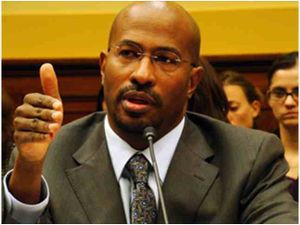 Van Jones is one of the more outspoken and now visible socialist radicals (a self-declared communist) in the Obama administration. The record of his outrageous remarks and speeches has now come to light and given rise to several members of Congress to call for his resignation, and to bring under congressional review the entire scheme of these extra-constitutional ‘czar’ appointments that are making potted plants out of most Cabinet secretaries. However, the ‘light’ on this issue does not shine uniformly from across our vaunted journalistic industry. As of yesterday, a search of Nexus revealed zero coverage of the growing controversy from the flagship editions of leftwing MSM outlets NBC, ABC, CBS, New York Times, and Washington Post. Because the White House has started issuing statements on this, they are finally taking their cue and beginning to open up. Pravda used to operate this way, and today still does. This kind of black hole journalism is not uncommon from the left, and I’d be interested in hearing about similar behavior from the more conservative news outlets.
[update] The WSJ tonight reports that Van Jones has indeed resigned after issuing two apologies that apparently were not sufficient to have Obama waste any more of his diminishing political capital in defending this man. We do recall, that all this went down despite that the cited MSM outlets attempted a news blackout on the story during the past week.
NPR is going to do a little educational piece on ‘stochasticity’ this weekend. (locally on KJZZ 91.5 at 3pm Sunday 6sep09) The lay definitions of this term are all over the place and mostly incorrect or, at best, imprecise. But the fact that a liberal media outlet is educating its listening public to something, the understanding of which is anathema to collectivization and social engineering, falls somewhere between remarkable and astounding. But then again, maybe they don’t know what they’re doing.
 Understanding stochastic processes is critical for a deeper appreciation of how social policies will/do operate in the real world. Formally, a stochastic process is a complex process that involves at least two random processes. These random processes may be inputs to the stochastic process, and/or they may prescribe (some of) the internal workings of the stochastic process itself. A random process is one the output of which is known only to within a probability (distribution); the outcome of a thrown die, or a drawn card are examples of random processes since the probability distributions of each outcome are known. However if the process is, say, throw a die AND draw card, based on the result drink a beer if you get an even number AND a face card, else drink water, then the resulting drinking behavior is a stochastic process. The outputs of stochastic processes are uncertain and, at best, known to within only a probability distribution. And even if known, the probability distribution may be such that it is not useful for planning/control purposes (but that’s another story).
We live in a universe that surrounds us with stochastic processes, and our success in life is to a large extent due to our ability to identify and satisfactorily behave in such environments. Statist social scientists and politicians don’t understand this, and exhibit their ignorance by continually coming out with policies that don’t account for stochasticity (and other complexifying factors).


 rebanesruminations.com
Leave a comment