

George Rebane
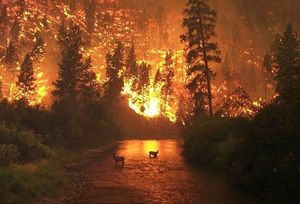 The newspaper’s headline blares that ‘The Yuba Fire 30% Contained’, you nod your head thinking that it is good news since yesterday the fire was reported to be only 5% contained. But then you take a look at the published burn area maps for the last two days and see that today’s fire area is significantly larger. And then you realize that you still have no idea what it means when someone tells you that a wildfire is X% contained.
Jo Ann and I have lived in wildfire zones almost all of our lives, and have experienced the range of emotions as wildfires raged near our homes in Simi Valley and the Santa Monica Mountains. One of them (1993 Malibu fire) actually swept over our property and burned our house after having incinerated our four nearest neighbors down to the foundation bolts. A fire crew from Placerville put out the fire and saved our house that was pretty much trashed with a 12 foot hole in the living room ceiling. But it was a lot better than being greeted by just foundation bolts.
During all those years we kept hearing the various ‘percent containment’ reports. Being a techie, early on I asked both fire fighters and on site journalists what such reports meant. No one could give me an answer. The fire fighters kept asking each other and their local team leaders, and always concluded that it was some kind of number that was generated in some mysterious fire fighting control headquarters in the sky. None of journalists were interested in the question and begged off, saying they just reported what they were told by fire fighting public relations wonk.
This was not a satisfactory conclusion, so I started devising all kinds of different fire control metrics and discussed them with other techies at work. Many of them related similar experiences. So we all had some fun at the chalkboard (before whiteboards) devising quantitative metrics that satisfied various observation system constraints and fire fighting utility functions. And, of course, after a while life intervened, and the years rolled on. Every time Jo Ann and I heard another fire containment report, we just looked at each other and shook our heads. Occasionally I would bring up the question at a dinner party, and people would stare at me with the ‘there’s Rebane asking another one of his stupid questions’ look.
So with the Yuba fire is now burning nearby, and this morning’s Union banner – ‘Yuba Fire 30% contained’ – on our breakfast table, I revisit my stupid question – how do you measure wildfire containment?. After all, this is the age of the Internet, and I should be able to pull up the answer in no time, right? Wrong.
After googling Google, Bing, WolframAlpha (what a loser this has turned out to be!), MS Live Search, and Wikipedia, my best result is from thinkquest.org. Drum roll please –
Fires can also be described as “out of control” or “contained” and they may give a percent as well. Out of control fires are spreading rapidly. For several days during the California wildfires, the fires were completely out of control with winds and warm temperatures helping them spread. Containment means bringing a fire under control. For example, a fire that is 100% contained is not out but is completely under control and not spreading. A fire that is 80% contained still has 20% that is not yet under control and could be spreading.
So there you have it. The worthy who wrote this little piece of prose actually thought s/he had answered the question. This is pretty close to what Mad Magazine sagely observed years ago – ‘Did you know that the moon is 1/49th the size of the earth, even though it is further away?’ Maybe this is what today passes for much of our communications.
If there is anyone reading this who does know how wildfire containment percentages are determined, or knows of someone who knows, then please let us all know. Here I bravely use ‘us’ in the unfounded belief that there is someone besides me who is interested – but then again, maybe not.


 rebanesruminations.com
Leave a comment