

George Rebane
The rise of conscious machines has become an active focus of study in the artificial intelligence community. Consciousness and intelligence can and should be viewed as independent attributes of a biological critter, and therefore by extension, of a sentient (conscious) and sapient (wise viz intelligent) machine. RR readers are familiar with my view that such machines will not be ‘programmed’ per se, but will arise from within very complex computational environments that may or not have inputs from our real world.
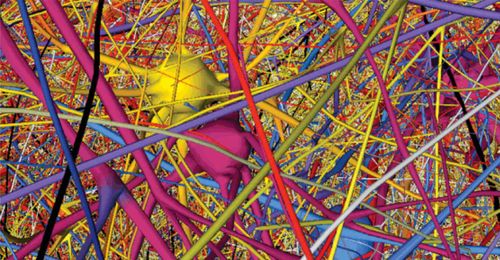
We now hear of a team at the Federal Polytechnical College in Lausanne, Switzerland that has ‘assembled’ the beginnings of a virtual rat’s brain from the ground up. (more here) This means that they have created software structures that mimic the make-up of (a part of) the rat’s brain down to the neuronal level, with each virtual neuron having all the inter-connections that a biological neuron would have in the brain. This creates a virtual brain with a gazillion such connections the complex firing patterns of which are thought to give rise to intelligence, and perhaps even consciousness.
Why so? Well, because when we peek at human brains at this level of detail, we see similar patterns of neuronal activity. And we’re all conscious and smart, aren’t we (at least most of us working outside the Beltway)?
Starting today with a 22.8 teraflop supercomputer (Blue Brain from IBM, 22,800,000,000,000 operations per second), the Lausanne team expects to take about ten years to develop a virtual human brain. If and when that happens, it’s gangbusters and the news will be full of special commissions meeting to discuss how this brain should be, as the song says, “carefully taught”. The problem at that point will be that no one knows what will happen when this machine quickly graduates from ding-dong school and wants to learn more, and here’s the scary part, it wants to start doing something. All we can be fairly sure of is that it will learn a lot faster than any human critter with the same level of complexity between their ears.
Somewhere in this sequence the machine will be subjected to some kind of ‘cognitive testing’, perhaps including the now 60-year-old Turing Test. For a little background on this, please read ‘Is It Time for the Turing Test to Retire?’ and the discussion thread on consciousness with Dr. Keith Dutton that follows it. Dr. Dutton is a systems scientist whose background includes a heavy dose of pattern analysis and quantitative methods in experimental psychology.
I anticipate that Blue Brain will have a lot of competition from computer science teams working concurrently in China, Japan, United States, and perhaps even Russia. Being the first team to build and nurture machine sentience or even peer sapience will be at least equivalent to Apollo 11 putting the first men on the moon forty years ago today. IMHO, it will be a much greater achievement, for it will herald the Singularity.

 rebanesruminations.com
Leave a comment