

George Rebane
While Congress is crafting climate and energy rationing legislation (HR2454) destined to cripple and/or destroy our country’s economy (see NC MediaWatch), there is yet another blow on the way – Obamacare. As the old song sang – ‘If the right one won’t a-getcha, then the left one will!’
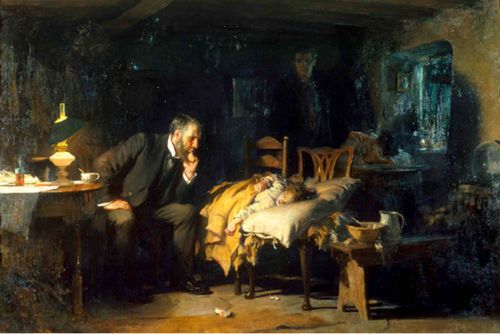
(A physician tends to a mortally ill child in Sir Luke Fildes’s 1891 painting ‘The Doctor.’)
The left one, now going through the back rooms of the Capitol, is the loudly promised ‘Healthcare Reform’ that will redefine and regulate over one-sixth of our GDP. How this sausage is being made cannot stand the light of day it so badly needs. Our President is again demanding that another historical revision of our society be rushed through with minimal visibility, congressional comprehension, and public debate. In spite of this we should, while we still can, all take the time to study and tell our electeds our opinions on the matter. In this piece we take a look at some national and local analyses of this critical issue.
The Cato Institute recently completed Policy Analysis #638 ‘Obamacare to Come – Seven Bad Ideas for Health Care Reform’, where we read –
While the Obama administration has not, and does not seem likely to, put forward a specific reform plan, it is possible to discern the key components of any plan likely to emerge from Congress:
• At a time of rising unemployment, the government would raise the cost of hiring workers by requiring employers to provide health insurance to their workers or pay a fee (tax) to subsidize government coverage.
• Every American would be required to buy an insurance policy that meets certain government requirements. Even individuals who are currently insured — and happy with their insurance — will have to switch to insurance that meets the government’s definition of “acceptable insurance.”
• A government-run plan similar to Medicare would be set up in competition with private insurance, with people able to choose either private insurance or the taxpayer-subsidized public plan. Subsidies and cost-shifting would encourage Americans to shift to the government plan.
• The government would undertake comparative-effectiveness research and cost-effectiveness research, and use the results of that research to impose practice guidelines on providers — initially, in government programs such as Medicare and Medicaid, but possibly eventually extending such rationing to private insurance plans.
• Private insurance would face a host of new regulations, including a requirement to insure all applicants and a prohibition on pricing premiums on the basis of risk.
• Subsidies would be available to help middle-income people purchase insurance, while government programs such as Medicare and Medicaid would be expanded.
• Finally, the government would subsidize and manage the development of a national system of electronic medical records.
Taken individually, each of these proposals would be a bad idea. Taken collectively, they would dramatically transform the American health care system in a way that would harm taxpayers, health care providers, and — most importantly — the quality and range of care given to patients.
One of the major points this analysis also makes is “the often repeated promise that ‘if you are happy with your current insurance, you can keep it’ is simply not true.”
Then last week the 20jun09 WSJ published a comprehensive survey article – ‘The Myth of Prevention’ – on the cost and overall utility of preventive medicine per se. The presented data and conclusions are surprising and should be known to us all as our country seeks to radically transform one of its fundamental service industries – an industry that will affect all of us sooner or later.
Closer to home, correspondent and Nevada County physician Dan Bibelheimer, MD sent me a report on the atrocious state of medical affairs in McCallen, Texas that appeared in The New Yorker. This 23jun09 piece – ‘The Cost Conundrum: What a Texas town can teach us about health care’ – was written by Atul Gawande, MD, a celebrated east coast surgeon and author.
Finally, Dan Bibelheimer has allowed me to make available his report on two national medical leadership conferences – the National P4P Summit and the World Health Care Congress – which he recently attended. The report ‘View from the 3rd Floor: Healthcare Reform’ can be downloaded here .
Now it’s our turn to let our conclusions be known, or we can just sit there and let someone else believe they know what we want.
 rebanesruminations.com
Leave a comment