

George Rebane
The WSJ has now joined a small group of news outlets that is testing the use of influence factors diagrams (IFDs) to explicate matters of public policy, economics, and the workings of social systems in general. I’m not sure this is a breakthrough yet, but the direction is encouraging.
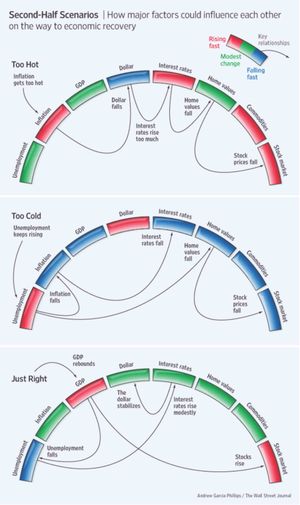 In the 8jun09 WSJ Mark Gongloff writes a short article ‘Landmines Pock the Road to Recovery’, explaining what things can go right and wrong with the recovery. He uses the Goldilocks approach of ‘too hot, too cold, and just right’. There are many factors that interact in each of these scenarios, and the article would have to be a lot longer than a couple of pages if he didn’t use the graphic IFDs to help out. In fact, writing it out would probably have made it unreadable, in addition to being almost impossible to understand. From all those words, the reader would have had to cobble together an IFD in his head, which is what we do anyway in such cases.
In the system sciences we have used IFDs for decades in the design, explication, and documentation of complex systems. Over the years a lot of systems science concepts and terms have leaked out into common usage – ‘in the loop’, ‘feedback’, ‘on line’, … . At the outset their use is always resisted by the philistines and rejected as ‘jargon’. But let some years pass as the underlying technologies become more familiar, and then the non-techies will finally see the benefits, and our everyday language expands and becomes more efficient.
I gave an introduction to all this on RR last August, and pointed to the use of IFDs adopted by the social sciences in a sub-field they call ‘cultural analytics’. A more fundamental tutorial on understanding IFDs was part of my lecture series on numeracy at the Madelyn Helling Library a few years ago (also posted as a SESF Numeracy Nugget). What I have found over the years is that our language is beginning to acquire new words more rapidly with the passage of time and the acceleration of technology. This is good.
But in my experience, the main pushback to the facile expansion of our language is still the legal profession which refuses to expand, beyond a glacial pace, its “terms of art” used to write contracts, laws, regulations, etc. I have lost count of the number of times I have explained to lawyers the underlying points of a contract, licensing agreement, etc. using clear flow diagrams, IFDs, and other suitable graphics from my field. They have always appreciated and understood that form of explanation, and they have always agreed that it is the clearest and simplest way to communicate the complex material.
But then they always retreat to their offices and return with hernia packs of paper scribbled with incomprehensible text, text that the principals – in this my counterpart and I – have a hell of time relating to the points that we agreed on. And, of course, we are never alone in this experience. Take any contract or agreement written by one lawyer and have another one read it. You’ll be paying a lot of billable hours for them to understand exactly what the other guy meant, and then have to listen to his/her critique of how it could have been done better. All the while the meter is ticking. Obfuscation for this profession is simply money in the pocket, and these are the same guys that populate our legislatures.
“I find endless challenge in the complexities of the law.” Judge Sotomayor on why she chose to become a lawyer (NPR 26may09). So do we all lady, so do we all.
Anyway, take a look at these WSJ diagrams and see what you think of them. They could have been made a little more complete by showing some feedback loops which are always present in real world situations. For example ‘unemployment keeps rising’ is not just a pure influence from outside the system (‘exogenous input’ for you techies), since unemployment is actually driven by the overall economy that in this case is represented by GDP. But for now that is a fine point and can be included later after the newspaper’s readership becomes more familiar with IFDs. I think Gongloff did a good job.
 rebanesruminations.com
Leave a comment