

George Rebane
 P.J. O’Rourke wrote a wonderful reprise of America’s love affair with the automobile in yesterday’s (30may09) WSJ – ‘The End of Our Affair’. The WSJ and our local Union are our morning papers that get us through breakfast in the comfortable, old-fashioned format. Jo Ann and I divvy up the various sections of the two papers, read, trade sections, and gab about what we’re reading. Mostly what we focus on are the in-depth pieces, features, commentaries, and editorials. By morning, the news in pulp publications is old hat; we already got that online last night, and woke up to NPR’s version of the world. So, as the old song says, ‘everything’s up to date in Kansas City’ by the time we’re eating cereal.
But, as I got about five inches into O’Rourke’s piece, a stable part of my world suffered a sudden jolt, and when the dust settled, it had a new crack in. PJ had blown it, and blown badly the explanation of horsepower, the notion that was central to his exposition of the American psyche and our love affair with cars. I mean, it wasn’t a slip of a word or two – he went on and on, telling those who knew what he didn’t.
Now to me PJ has always been the street-smart, self-effacing, humor wordsmith who underneath was obviously a well-read intellectual. He could deliver up arcane issues and topics in a secret sauce that made you laugh and at the same time say, ‘Sumbich, I didn’t know that.’ But yesterday he exposed a part that I (and, perhaps, many others) didn’t want exposed, and now we need to recalibrate the man.
You see, PJ doesn’t know the difference between power and energy – that’s the same as not knowing the difference between the job of the gas tank and the engine of a car. That’s no big nevermind for today’s younger generation, they were doomed by an educational system dominated by teachers unions spewing self-esteem. But PJ grew up in the fifties, when every teen-age boy with an interest in powerful cars knew that horsepower was not the energy stored in the gas tank. We all knew that you could have gas and other chemicals in a quart bottle that would explode a dragster with a monster engine and big slicks down a quarter mile strip faster than you could say, … well, pretty damn fast.
Power was what the engine delivered to the wheels, and the more power, the faster it would drain that quart bottle of fuel with all that stored up energy. As kids, we all knew that (horse)power was the ability to take that energy and use it to do useful work. Yeah, in those days we considered moving a 1,500 pound modified hotrod from 0 to 60mph in 5 seconds useful work. And wasn’t PJ also one of us in those days?
At this point many of you may be saying, that’s all technical crap that no one cares about – and you’d probably be right on both counts. Our country is in a heap of trouble because no one has cared about such differences. The Chinese do care about that, and that’s another story. But let’s get down to a little more nitty gritty level on issues that people might (should?) care about – the current financial crisis and policies being implemented to end it.
National debt is to deficits as energy is to power. They’re totally different things, and I’m afraid that the polls are right. Only a small fraction of our adults know the difference between national debt and deficits. In such ignorance, they have no ability to understand or enter into any reasonable debate on policies relating debt to deficits.
PJ should have explained to us that power is the time rate of change of energy – the difference between how the engine sucks up gas (energy) and delivers shaft torque at a given rpm to move the car or a mountain. He might also have thrown in that speed is the time rate of change of distance, so that a few more light bulbs would have gone on. There’s an enormous difference between something and its time rate of change – like the capacity of a leaky bucket, and the size of the hole in the bottom that drains it.
In the same vein, our government’s budget deficit is the time rate of change of national debt. Not knowing the difference between deficits and national debt allows the TV’s talking heads to sagely rediscover for us that ‘even though the deficit went down this year, the debt is still higher than last year’s.’, and ‘even though this month’s newly unemployed came in lower than last month’s, the total unemployed number keeps stubbornly going upward.’ Well, no s**t Red Ryder, and they pay you how much for that drivel?
So I don’t know what to think of PJ’s future columns on taxes, tax rates, national debt, deficits, bailouts, stimulus packages, … . I’d like to believe that it was just a slip of the lip, and maybe just confined to things automotive; and that he’s really up with all the rest of the stuff on finance and national policy. But in his article he just kept going on and on, not having a clue. I will have to work hard putting this Humpty-Dumpty back together again.
Anyway, I was going to send a couple of friends with automotive and aviation interests a note about PJ’s otherwise great compendium and reminiscence of our long love affair with things moved by powerful engines. But then I remembered that one of the friends is an accomplished antique car aficionado who also reads the WSJ every morning, and who should really be the one to notify the rest of us about this article – and perhaps without including a diatribe about PJ’s error. So I didn’t, and, sure enough, he did. His email to all of us arrived yesterday in a timely manner.
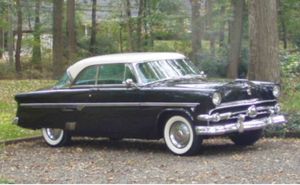
(The 1954 Ford Victoria pictured above was the Rebane family’s first love affair with affordable high-powered cars. On a Sunday morning in 1956, after having just gotten my driver’s license, mom sent me to the store to pick up some bread and eggs for breakfast. It was one of my first times in the car alone. The country roads south of Indianapolis were mostly empty at that hour. The car was a stick shift with overdrive, and Ford’s most powerful V8 for that year under the hood.
So let’s see, All-American teen-ager, powerful car, empty straight roads, flying solo – all the necessary ingredients for exploring the envelope. Before I even knew what I was doing (standard MO for a teenager), I had that two-door hardtop screaming south on Highway 37 with the needle creeping up to 110mph (the speedometer maxed at 120). I’d never driven over 70 before, and at 110mph I felt that the car was definitely not hugging the road – the notion of ‘floating’ came to mind. The thrill lasted less than a minute before I came to my senses, and concluded that the car’s power-train and suspension were designed for different purposes.
Neither my parents nor the Indiana State Police learned of my Sunday morning foible. But for me it was a powerful, intense, and rewarding spurt of self-discovery – I was also very lucky that morning.)


 rebanesruminations.com
Leave a comment