

George Rebane
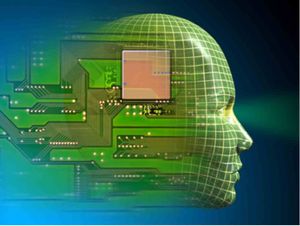 Let’s look ahead ten years or so. You have finished lunch and are about to go back to work when you see something in a store window and go inside. You examine the article and decide to pull up a couple of similar articles for comparison. By thinking a command you make an overlay display appear in your field of view. You are already on line as was your cell phone back in the old days.
You now move the cursor on the browser’s interface to ‘thought recognition’ and by thinking, you command the browser to go to your favorite ecommerce aggregator’s site, and call up similar products by simply looking at the product’s barcode in your hand. The displays of competing products appear in a matrix in front of you, which you examine while expanding certain features, and then you make a decision. You will buy the article in your hand from the store’s website, and have it shipped to your home. Moving the cursor while ‘clicking’ on some links, and you’re done shopping.
You now ‘hear’ a silent voice that reminds you of the early afternoon meeting during which you will make a presentation. The shopping detour will make you a little late to the meeting, and you decide to call your assistant to tell everyone that you’ll be late. Again by thought, you pull up the communication interface and by thinking your assistant’s name and silently commanding ‘call’, your assistant soon answers and you recognize the familiar voice. Without moving your lips, you quietly tell her of the schedule change, and then decide that you will text the notification to the other attendees yourself.
Again by thought, you form the text message and command its transmission to your colleagues as you walk toward your office building down the street. It occurs to you that there is a slide in your PowerPoint that you forgot to include. You pull up your presentation, and it floats in front of you as an overlay of the passing scene during your brisk walk back. Quickly you identify where the new slide will go. Its composition will require a bar chart that combines both your corporate data with some census data from the Department of Commerce.
Again, while walking, into the building you pull up the corporate data array, with a cursor select the part you want, go on line to a government site that you had bookmarked and grab the corresponding data you need. Before you get out of the elevator, you have composed the needed bar chart and inserted the new slide. As you walk to the conference room, you pull up and view your afternoon schedule and the emails in your inbox.
Your colleagues are already assembled in the conference room, some chatting, some quietly staring out the window, working as you have been while your returned from lunch. People greet you as they sit down. Again by thought alone, you upload your revised PowerPoint to the company’s data archive and command the conference room display system to bring it up for viewing as you begin your presentation in ‘traditional mode’.
You and your colleagues decided to attend the presentation as a group because old habits die hard, and you did want to discuss it face-to-face using normal human interaction. There are still some things you can get from face-to-face that you can’t from a machine user interface You could, of course, have done all this on line with everyone in their office/cubicle ‘viewing’ and ‘hearing’ the presentation with complete ability to interact.
This scenario seems farfetched to many people today, but the essential technical elements to achieve what I have described are already in place. The above vignette describes a small part of the enhanced functionality humans will have when they get upgraded with Machine Augmented Man (MAM) technology. With ongoing miniaturization, direct neural/brain connections, and control-via-thought, all of these things will be possible in the near future. RR has already documented a steady stream of these advances in this blog’s Singularity Signposts section.
It turns out that the human body is an excellent substrate for a network. Its tissues can act as a conduit for electrical signals over a wide range of frequencies. To do what I have described requires that we have an appropriately encapsulated computer and battery pack (like a pace-maker, smaller than a deck of cards) embedded somewhere in our torso. The battery will be recharged via trans-dermal (through the skin) magnetic coupling. There will be another much smaller processor near your head with very thin wires run under your scalp to appropriate places over your brain. For instance, there will be some of these pick-off devices (transducers) that will cover the visual cortex that is the back part of your brain. Think of this as being the visual display (i.e. monitor) which generates the overlaid screens described above. The whole subsystem can be thought of as a network device in your body’s MAM network.
The main processor will also have wireless connectivity and GPS functionality built in. Not described here, but undoubtedly included as a part of your MAM system will be a group of micro sensors and stimulators embedded near/at various organs, glands, blood vessels, and nervous system. These will monitor your body’s homeostasis indicators and stimulate various body parts to do more (or less) to keep you in tip-top shape. Your current physiological state can always be uploaded to the office of your local sawbones (or state run health data center?).
At this level of MAM development you will have definite cognitive advantages over your un-augmented brethren. You will be able to unobtrusively call up any and all information lodged on the web – for example, think of getting answers from the much upgraded Google search and WorlframAlpha knowledge computing engines. You will be able to instantly discourse on an unimaginably wide variety of topics to entertain, amaze, and/or bore your friends. If you’re smart enough to formulate the question, the answer will be yours in seconds.
But at this stage there will still be many topics about which you will not be able to carry on like a bleeding genius. These topics will primarily be in technical areas where a different mode of thinking, not available to the non-technician, is still required. But in procedural areas like medicine, we will all be able to diagnose and prescribe for most conditions with the best of the then world medicos. Why is that?
Medical diagnostics are highly formalized, and can therefore be captured and canned in AI engines such as Bayesian networks. This work has been ongoing for the last twenty years, and now there are many areas of medicine in which the computer can lead the human physician or layman through complex processes of figuring out what’s wrong to what’s required to make it right. And, of course, this will not be limited to just human bodies, but any kind of gizmo valuable enough to warrant fixing. (As far back as the early eighties my company introduced and developed the technology for crew members of combat aircraft to perform complex diagnostics and perform repairs if forced to land at an airport of opportunity.) So when you access an online medical AI, you will be calling into action the best minds in medicine – the so-called ‘domain expert’ – whose knowledge and experience is embedded in the medical expert system.
One of the cognitive functions on which you will still have to rely on your native intelligence is innovation. Innovation is that component of intelligence which heavily depends on the ability to recognize patterns in space and time within the background of irrelevant data or noise. Patterns in time are usually procedures or algorithms that nature or humans use to accomplish something like convert hydrogen to helium or make a board out of a log.
At this level of MAM you will be able to quickly access data and rearrange/process it to make information. But in the end you’ll still have to dig out and evaluate the pattern yourself. Make no mistake though, chances are very high that the individual with MAM will significantly outperform his/her un-augmented colleague who is in other ways equal. And this brings us to one of the difficult problems of our pre-Singularity society.
MAM implants will cost money and be initially expensive, as are all leading edge technologies. People who are intelligent, educated, and/or rich will be able to distance themselves further from the rest with MAM than those lacking one or more of these attributes. There is no doubt that providing MAM to the mildly intelligent will increase their ability to sell their labor into more markets – with the above caveats regarding innovation – and this might be a stabilizing factor for our population. (For example it’s not clear whether the nation’s sub-par math teachers – more here – will be more qualified with MAM.) However, with the continued acceleration of technology, it may be a very short-lived one.
In any event, this issue is receiving much attention within the technology and some related sociology communities. Conferences are already addressing questions such as “will designer brains divide humanity?” Sadly, Americans will not know about this for some time, and then their emotions will be appropriately managed by the same people who daily bring us our bread and circuses. But you will know.
 rebanesruminations.com
Leave a comment