

George Rebane
The flow of federal monies is always of interest to me in the sense of who are the net exporters of cash and who are the net importers. That information has been harder to assemble than I thought, so while doing a recent search I was pleased to stumble onto the Northeast Midwest Institute’s website (yep, that’s their real name) and the link to their economic data page. From there you can pull up a lot of tables comparing how federal monies go to the various states – you have to first scroll down to the ‘Federal Spending’ section.
Of particular interest is the table ‘State Ranking of Per Capita Spending, Per-Capita Tax Burden and Return on the Federal Tax Dollar: Fiscal 2005’. The right hand column gives the punch-line of the net exporters and importers. The states are ranked in order of total dollars received from Washington for every dollar sent there. Even though the data is a bit dated, I suspect that the relative order of things has not changed much, and that is of most interest. There we see that Mississippi gets the best deal with $2.02 coming back for every dollar sent. New Jersey is at the bottom of the pile getting back only $0.65 for their dollar, and California is also a net cash exporter, getting back $0.80 for our buck.
If you look at that third column, you quickly see where the cutoff is for which states do the paying (the ‘Peters’), and which states are the net receivers (the ‘Pauls’). Amazing to see states like Nevada ($0.67) and New Hampshire ($0.75) among the seventeen states that do all the paying. Getting a general feel for this information about the flow of federal dollars is also important from a larger perspective, and here it gets really interesting.
[Peter/Paul Principle: The politician who promises to rob Peter and pay Paul always has the whole-hearted support of Paul.]
The national debate on the future of capitalism, supply side vs demand side policies, and the effect of tax rates on the economy has risen to an historical level of sophistication and discord in the country. Those who study and think, and attempt to convince others of their gained wisdom still fall into the classical divide between the collectivists and free market capitalists. But now, bolstered with reams of data, both sides seem to have grown further apart than ever. We are now beginning to see the notion of what I call The Great Divide cropping up in more and more discussions of public policy and our future as a nation.
The Great Divide is a short name for a hypothetical scenario wherein both the right and left, unconvinced that they can continue joint governance of a nation to their mutual and individual benefit, decide to peaceably divide the nation into two politically semi-autonomous regions of states called, say, the American Confederation. Each region will govern itself within its distinct political philosophy under a new constitution that relegates to the central AC government few powers beyond foreign policy and defense. Commerce, trade, personal liberties, taxation, local control, etc. will all be decided by the semi-autonomous regions. Details to be ironed out later – remember this is only a hypothetical scenario to inform and expand our current national debate.
After the Great Divide is adopted, one presumes that there will be a period of migration as people move to the region in which they expect to benefit the most. After that we can expect to see each region be more homogeneous in its socio-political make-up, and able to pass and operate under laws that reflect their respective value and belief systems.
In past discussions where the Great Divide comes up as the solution to our national discord, I have noted that people of the Right are always ready to ‘bring it on’, while on the Left almost all are hesitant or negative about such a prospect. Drilling deeper in the conversations always goes to the ability to create enough wealth so that desired levels of government (collective) spending and income equalization can be imposed and still maintain the ‘chicken in every pot and two cars in every garage’ quality of life. In short, my experience has been that the left-wingers instinctively know that they live at the behest of the greedy, money-grubbing, risk-taking, don’t-tread-on-me entrepreneurs and free market capitalists. Their correctly perceived problem is how to tax and control us so that they can still get our money and not make us stop producing, or worse, go away.
But there is a small cohort of intellectual collectivists whose response to the above summary is ‘Balderdash!’, and in them lays hope for us all. These learned left-wingers believe that their socio-political philosophy is not only intact but superior to the primitive instincts that arise from distributed knowledge and control applied over a landscape of superfluous individual liberties. It is this small group of the Left with whom a reasoned debate may be had that has a chance of resolving the national discord one way or the other. I believe that with these folks it is possible to either agree that there is a future for the good old US of A, or that the Great Divide should be the next item on the debate agenda.
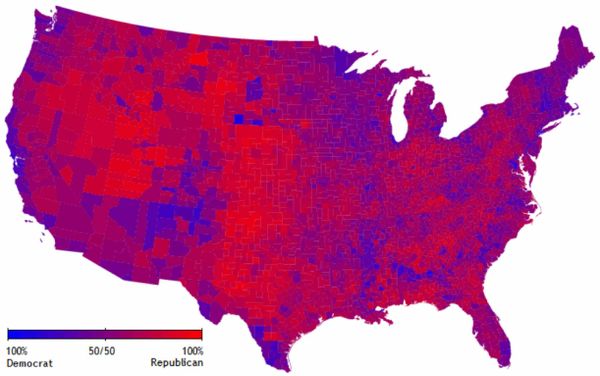
I have observed that the left-wing intellectual wants to start the discussion by pointing out that most of the cash exporting (i.e. net wealth generating) states are the ‘blue states’. And that in any Great Divide they would, of course, wind up in the Left Region. But that’s not necessarily so, because in the migration that accompanies the Great Divide, it is the people and their assets (save real estate) that move. We must always remember that in a democracy – especially within sight of the approaching Singularity – the Pauls will always outvote the Peters (see The Myth of the Rational Voter) thereby giving the state its cited color.


 rebanesruminations.com
Leave a comment