
Rebane's Ruminations
February 2009
S M T W T F S
1234567
891011121314
15161718192021
22232425262728

ARCHIVES


OUR LINKS


YubaNet
White House Blog
Watts Up With That?
The Union
Sierra Thread
RL “Bob” Crabb
Barry Pruett Blog

George Rebane

The hopeful diagnosis is that we are sinking ever faster into the socio-economic abyss; the more likely one is that we have arrived.  California’s budget crisis and its genesis should be well-known to RR readers, but the idiocy in the attempt to solve it in Sacramento is new.  The solution to our looming $42B deficit includes raising tax rates and giving more patchwork tax breaks – e.g to Hollywood to keep the film industry from moving out of state.
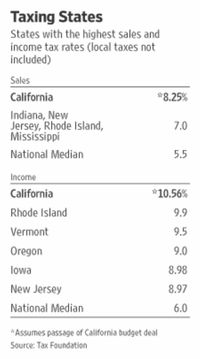
TaxTable As reported over the last year and again in this morning’s WSJ (here), our pols refuse to tackle the root cause of California’s financial problems – the state is no longer competitive in attracting businesses and high income people.  Reports abound that businesses would be “foolish to build another plant in the state.”  More than 1.4 million non-immigrants have left than arrived in the state during the last decade.  Simply put, them that can, go – and them that can’t, come.  Sporting the “most liberal legislature this side of Trenton” has produced a situation partially summarized by the nearby tax table which gives an inkling as to what’s going on.

Most people don’t have a clue as to how taxes work and how to think about income and sales taxes – for example they are not additive.  And this ignorance makes us the bleating sheep that we are.  Consider this simple question – how much does a Californian need to earn in order to buy something in California?  Well if you earn E dollars and the state’s income tax rate is TI, then you get to keep and spend E*(1-TI) of your earnings.  Then if you want to buy something with a price tag of P dollars on which the sales tax rate is TS, then you have to pay P*(1+TS) dollars for it.  Because the money you keep has to equal the money that you pay (unless you’re the government), we have the simple relation

E*(1-TI) = P*(1+TS)

Solving for the amount you have to earn gives

E = P*(1+TS)/(1-TI)

Note the factor (1+TS)/(1-TI) that multiplies price P, that is the total tax burden factor.  What makes it tricky is that the relation is non-linear, and grows much faster than simply adding together the income and sales tax rates to get the total tax burden that the wage-earner cum consumer must bear.  Let’s look at the California example using numbers from the table.

Total Tax Burden Factor = (1+TS)/(1-TI) = (1+0.0825)/(1-0.1056) = 1.2103

This says that for every dollar of stuff a Californian wants to buy, s/he has to earn $1.21 or bear a total California induced tax burden of 21%.  And if all this is not bad enough, there are more local taxes and fees.  This tax burden factor really takes off when you add in to the income tax rate all the other income related taxes – e.g. federal income tax.

But ignorance does not stop at the state house steps.  For example, our Nevada County does not pay much attention to such matters, and instead is directing its meager economic development funds to programs that will attempt to attract manufacturers to these mountains while ignoring the growth of its natural cash importers – the tourists and retireds.  Adding such policies to what is already coming from Washington and Sacramento yields a triple whammy for us simple hill folks.  B-a-a-a-h!

[update]  Readers will note a lot of claims from our liberal friends that Keynesian government spending creates economic multipliers for GDP in the 1.6 range, while tax reductions are barely noticeable at somewhere around 1.05.  (Here’s a little update on the multiplier)  This is the big argument that the left is using today to convince the miniscule fraction of the electorate that can still rub two brain cells together and think.   The rest of us just roll our eyeballs and tune in American Idol. Well, there are other views of what the Keynesian multiplier has achieved historically during government spending sprees.  Here is a recent one from Harvard economist Robert Barro.  The question that we’re always left with is, if government spending is so effective, then why should we stop at a mere trillion – why not let ‘er rip and have the government just spend us to unassailable prosperity?

And as I’ve argued on several comment threads and previous posts, the bases for analyzing the spending habits during (not ‘of’) previous administrations is a very complex matter.  Liberals, now led by Obama, have an established litany of Bush bashings that get trotted out as revealed truth.  Yes, the Republicans spent too much for Republicans, but take a look at this new piece ‘Who Are the Big Spenders?’ by Randall Hoven in The American Thinker.  Thanks to Russ Steele for the link.

Posted in , , ,

21 responses to “‘Hyper-Progressive’ California (updated)”

  1. Russ Steele Avatar

    George, great job but that is only the beginning of the problem, CARB and CPUC have yet levied the all the carbon taxes yet. We have already seen some in our natural gas bill, but there are more to come. I blogged about the new carbon taxes at NC Media Watch that will be additive to the existing taxes. The carbon taxes are being propose to satisfy the provisions of AB32.
    • Gasoline and Diesel Carbon Tax: 27 to 235 cents per gallon by 2020
    • Electricity Carbon Tax: 84 to 172 cents per Kilowatt hour by 2020.
    • Natural Gas Carbon Tax: 53 to 315 cents per million Btus by 2020.
    The taxes above are presented as ranges, because CARB has not determined the ratio of each necessary to achieve the mandated greenhouse gas reductions. Now I ask you what company could survive when similar companies are not paying the same carbon taxes in neighboring states. They cannot compete under those circumstances. What company would elect to come to a State with the highest carbon taxes and the highest sales taxes in the nation?

    Like

  2. George Rebane Avatar

    Agreed Russ. Too many points to cover on this dive to the bottom. The fundamental problem is still a totally different worldview that the liberals have. They are winning because their message is simple, they are active in changing public policy, and we are just mumbling in our beer. I wonder what fraction of coservatives/libertarians are contacting their electeds on a regular basis. What goes between tiny and negligible?

    Like

  3. Wade Avatar
    Wade

    It is also worth pointing out that, when the multipliers are calculated, food stamps are typically on the high end of the scale and military / war spending on the low. Almost always < 1 so, in a narrow sense Barro is right on the money, so to speak…

    Like

  4. George Rebane Avatar

    I hope my point that there are many ways to measure an ecconomic multiplier is not lost in all this. The system for which such a multiplier is measured is always complex and always subject to exogenous economic and other inputs. In the final analysis the process reduces to what is called an estimation problem – a formal area of systems theory, which I’m sad to say, not many economists and ‘analysts’ are familiar especially due to the heavy involvement of stochastics. Bottom line, both sides can skin the cat in more than one way which will suit them.

    Like

  5. Wade Avatar
    Wade

    Granted, these calculations are complex. Point taken. It is still a weird article to reference for you, I think, in that it:
    a) affirms the success of the New Deal
    b) clearly states the ineffectiveness of military spending as economic stimulus but fails to carry the point effectively over to all domestic spending
    c) uses as exhibit A, a set of economic policies (those in place during WWII) largely anathema to free market, supply side fundamentalism e.g. price / wage controls, rationing, demand suppression, tight supply regulation, conscription, significant disruption of global markets ,etc.
    It is not weird for you in that:
    d) it calls for tax cuts targeted at corporations and the wealthy
    Also, Brad DeLong responds to Barro:
    http://delong.typepad.com/sdj/2009/02/evidence-logic-and-robert-barro.html

    Like

  6. Mikey McD Avatar

    George, what states are the most appealing (lowest tax rates)?

    Like

  7. George Rebane Avatar

    Yes, weird maybe. You can think of it as an attempt to reach over the aisle.
    I fantasize that we (here on RR and other people of goodwill) can put our considerable talents to work solving problems of governance – e.g. the generation and distribution of wealth – if we could perhaps first agree on what the governance utility function (GUF) should look like. Given a broadly acceptable GUF afo (as a function of) public policy decisions, there may be a way for us to extremize it. And consider what it would say if we could not even find common ground in defining a GUF. Would that not be a reason to seriously consider a peaceful path to the Great Divide? I will try to address this in the near future, and hope that readers will be interested enough to apply the proper shape and polish to it.

    Like

  8. George Rebane Avatar

    Re most appealing states. Don’t know that there’s an absolute ranking or rating, because it all depends on the stage of life you’re in and what business/investment interests you have. Here’s a resource that let’s you check out the states individually –
    http://www.retirementliving.com/RLtaxes.html
    And here’s a good article that covers the extremes along with discussing the overall “most appealing” issue.
    http://articles.moneycentral.msn.com/Taxes/Advice/TheBestAndWorstStatesForTaxes.aspx

    Like

  9. Wade Avatar
    Wade

    Mikey –
    Based on a number of factors, with taxes being prominent but also including things like quality of life, the top two for conservative-style business “friendliness” are Virginia and Texas. These two split the difference between low taxes / low service levels and just outright lacking the infrastructure, talent pools, etc necessary to modern business.

    Like

  10. Mikey McD Avatar

    If I were a leader in a “tax friendly state” I would be marketing myself to tax paying Californians. Wife and I have and continue to consider Alaska and Texas as new homes once the kids are out of school. Very liberty rich states (relatively speaking).

    Like

  11. Wade Avatar
    Wade

    Oddly enough, there are only 2 “business-friendly” states in the top 10 for GDP per capita, Alaska and Virginia, at #7 and #9 respectively. I wonder why the business “unfriendly” states like New York, New Jersey, and Massachusetts are so much more economically productive?
    It’s like there’s some strange disconnect between being “business-friendly” and actually doing business… In fact only 6 of the top 25 states in GDP per capita could be considered conservative / “business friendly.”

    Like

  12. Mikey McD Avatar


    Our “Leader”

    Like

  13. George Rebane Avatar

    Wade – can you please point me to the ‘GDP per capita’ data that you cite? I assume that it uses the GDP of the individual states and reveals how much federal money poured back into each state is included in that. Thanks.

    Like

  14. Wade Avatar
    Wade

    George –
    http://www.bea.gov/newsreleases/regional/gdp_state/gsp_newsrelease.htm
    Haven’t been able to determine federal expenditures in the overall “GSP” data but I might not have dug far enough. Let me know what you find…

    Like

  15. Wade Avatar
    Wade

    Interestingly though, both Alaska & Virginia have higher than normal federal monies “poured” into them…

    Like

  16. Wade Avatar
    Wade

    Our “Leader” is so stupid. What a stupid liar.
    You really want to get into verbal gaffes, blunders, & untruths, Mikey? There’s no way your boy compares favorably in that arena. To anyone, much less our current “leader.”

    Like

  17. George Rebane Avatar

    Thanks Wade. I found another site that has an interesting table of per capita fed taxes, inflow of fed funds, and rankings for 2005. Note the few states that are actually net cash exporters and therefore pay for the excess that the net cash importers get. More to be said about this I’m sure.
    http://www.nemw.org/fundsrank.htm

    Like

  18. Wade Avatar
    Wade

    George –
    This has been one of my pet points for many, many years. Yeah, the difference between the states that foot the bill for the federal government and the ones that are net federal freeloaders is a huge but oft overlooked in the national discussion (I think purposely).
    As a former New Jerseyan I am duly outraged as New Jersey gets the worst deal out of all 50, as low as 54 cents on the dollar in some years. Unsurprisingly most of the federal freeloaders are conservative, anti-federal govt, anti-tax states. They are blithely unaware that not only, as a state, they don’t really “pay” any federal taxes, but that they are the primary beneficiaries of liberal states paying federal taxes. It really is just a handful of states that float the whole enterprise. Talk about a Great Divide.

    Like

  19. Mikey McD Avatar
    Mikey McD

    One more bullet point on the list of “reasons why federal income tax is unfair”.
    As a republican senator once told me “My job is to make the pie as small as possible, but, once the size of the pie is known, I go after the biggest piece for my constituents.”

    Like

  20. Mikey McD Avatar
    Mikey McD

    “Mikey? There’s no way your boy compares favorably in that arena.” Who is “your boy?” If you say W,then you are not paying attention. The closest “boy” I respect amongst the looters in DC is Ron Paul.

    Like

Leave a comment