

George Rebane
The hopeful diagnosis is that we are sinking ever faster into the socio-economic abyss; the more likely one is that we have arrived. California’s budget crisis and its genesis should be well-known to RR readers, but the idiocy in the attempt to solve it in Sacramento is new. The solution to our looming $42B deficit includes raising tax rates and giving more patchwork tax breaks – e.g to Hollywood to keep the film industry from moving out of state.
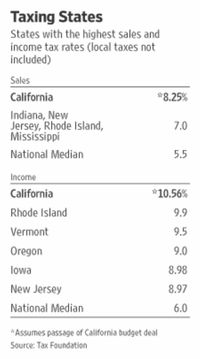 As reported over the last year and again in this morning’s WSJ (here), our pols refuse to tackle the root cause of California’s financial problems – the state is no longer competitive in attracting businesses and high income people. Reports abound that businesses would be “foolish to build another plant in the state.” More than 1.4 million non-immigrants have left than arrived in the state during the last decade. Simply put, them that can, go – and them that can’t, come. Sporting the “most liberal legislature this side of Trenton” has produced a situation partially summarized by the nearby tax table which gives an inkling as to what’s going on.
Most people don’t have a clue as to how taxes work and how to think about income and sales taxes – for example they are not additive. And this ignorance makes us the bleating sheep that we are. Consider this simple question – how much does a Californian need to earn in order to buy something in California? Well if you earn E dollars and the state’s income tax rate is TI, then you get to keep and spend E*(1-TI) of your earnings. Then if you want to buy something with a price tag of P dollars on which the sales tax rate is TS, then you have to pay P*(1+TS) dollars for it. Because the money you keep has to equal the money that you pay (unless you’re the government), we have the simple relation
E*(1-TI) = P*(1+TS)
Solving for the amount you have to earn gives
E = P*(1+TS)/(1-TI)
Note the factor (1+TS)/(1-TI) that multiplies price P, that is the total tax burden factor. What makes it tricky is that the relation is non-linear, and grows much faster than simply adding together the income and sales tax rates to get the total tax burden that the wage-earner cum consumer must bear. Let’s look at the California example using numbers from the table.
Total Tax Burden Factor = (1+TS)/(1-TI) = (1+0.0825)/(1-0.1056) = 1.2103
This says that for every dollar of stuff a Californian wants to buy, s/he has to earn $1.21 or bear a total California induced tax burden of 21%. And if all this is not bad enough, there are more local taxes and fees. This tax burden factor really takes off when you add in to the income tax rate all the other income related taxes – e.g. federal income tax.
But ignorance does not stop at the state house steps. For example, our Nevada County does not pay much attention to such matters, and instead is directing its meager economic development funds to programs that will attempt to attract manufacturers to these mountains while ignoring the growth of its natural cash importers – the tourists and retireds. Adding such policies to what is already coming from Washington and Sacramento yields a triple whammy for us simple hill folks. B-a-a-a-h!
[update] Readers will note a lot of claims from our liberal friends that Keynesian government spending creates economic multipliers for GDP in the 1.6 range, while tax reductions are barely noticeable at somewhere around 1.05. (Here’s a little update on the multiplier) This is the big argument that the left is using today to convince the miniscule fraction of the electorate that can still rub two brain cells together and think. The rest of us just roll our eyeballs and tune in American Idol. Well, there are other views of what the Keynesian multiplier has achieved historically during government spending sprees. Here is a recent one from Harvard economist Robert Barro. The question that we’re always left with is, if government spending is so effective, then why should we stop at a mere trillion – why not let ‘er rip and have the government just spend us to unassailable prosperity?
And as I’ve argued on several comment threads and previous posts, the bases for analyzing the spending habits during (not ‘of’) previous administrations is a very complex matter. Liberals, now led by Obama, have an established litany of Bush bashings that get trotted out as revealed truth. Yes, the Republicans spent too much for Republicans, but take a look at this new piece ‘Who Are the Big Spenders?’ by Randall Hoven in The American Thinker. Thanks to Russ Steele for the link.


Leave a comment