

George Rebane
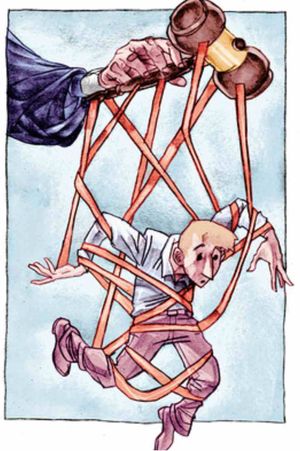 Today President Obama’s call for “a new era of responsibility” is stillborn. Most well-read people have known for some decades now that we have tied ourselves into legal knots that kill the spirit of initiative and freedom. Lawyer Philip Howard (chair of Common Good) in today’s WSJ writes ‘How Modern Law Makes Us Powerless’ – it is definitely worth a read before we suffer our next ‘Well, there ought to be a law …’ reflex response to some problem we hear about.
Regarding the immediate implications of our laws and lawyers dilemma, Howard writes
Here we stand, facing the worst economy since the Great Depression, and Americans no longer feel free to do anything about it. We have lost the idea, at every level of social life, that people can grab hold of a problem and fix it. Defensiveness has swept across the country like a cold wave. We have become a culture of rule followers, trained to frame every solution in terms of existing law or possible legal risk. The person of responsibility is replaced by the person of caution. When in doubt, don’t.
And our concept of freedom has become atrophied in that “(w)e think of freedom as political freedom. We’re certainly free to live and work where we want, and to pull the lever in the ballot box. But freedom should also include the power of personal conviction and the authority to use your common sense.”
The real problem comes down to “(t)he overlay of law on daily choices (that) destroys the human instinct needed to get things done. Bureaucracy can’t teach. Rules don’t make things happen. Accomplishment is personal. Anyone who has felt the pride of a job well done knows this.”
As a start to fixing things, we must restructure law to “affirmatively define an area free from legal interference.” But that will be no simple task.
Reviving the can-do spirit that made America great requires a legal overhaul of historic dimension. We must scrape away decades of accumulated legal sediment and replace it with coherent legal goals and authority mechanisms, designed to affirmatively protect individual freedom in daily choices. “A little rebellion now and then is a good thing,” Thomas Jefferson wrote to James Madison, “and as necessary in the political world as storms are in the physical . . . .” The goal is not to change our public goals. The goal is make it possible for free citizens to achieve them. (Emphasis mine)


 rebanesruminations.com
Leave a comment