
George Rebane
Here’s another ‘you can’t just do ONE thing’ development. MIT recently announced (here) that
Researchers in MIT’s Computer Science and Artificial Intelligence Laboratory (CSAIL) are working on a better way to handle supplies in a war zone: a semi-autonomous forklift that can be directed by people safely away from the dangers of the site.
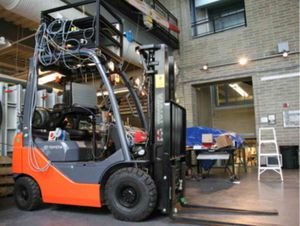 Well, that all seems like a good idea. That little puppy pictured nearby will learn the layout of warehouses and loading docks, and then accept high-level directions (‘Unload truck from Dock 7 and stack pallets in Warehouse 3 Sector 19.’) to do its job. Most of you are already ahead of me – how long until such operations become common in more peaceful environments stateside? And what do we do with the people who used to earn a good living driving these things? Many (most?) of these people cannot be retrained for jobs that successfully (pay per performance) compete with machines in other sectors of the economy.
As we approach the Singularity, such technological advances will permanently displace workers with limited abilities to learn more sophisticated skills. The smart machines are pushing us out of our traditional workplaces more rapidly than ever. And no one should dream on about this just happening to a few workers out there with ‘learning disabilities’. We’re talking about tens of millions of more Americans who will soon be looking to the government to sustain them in one way or another – the operational word here is ‘more’. No one today seems to want to think about this Singularity signpost very much.
 rebanesruminations.com
Leave a comment