

George Rebane
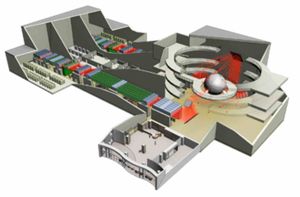
Worldwide lunacy is achieving new heights. The Europeans are launching a major multi-decade project to create a practical energy source using fusion. This project will cost megatons of money – some will undoubtedly even come from the US – and seek to create energy independence from carbon based fuels. The story is told by Peter Glover in the TCS article ‘Fusion Energy: Europe’s New Holy Grail’. In it he outlines the HIPER (High Power Laser Energy facility pictured above) program to demonstrate that humans can create a slowly exploding hydrogen bomb in a controlled space that outputs more energy than is required to sustain the explosion.
Fine and good, and some day we will, no doubt, have fusion energy. But even with HIPER, the attainment of practical fusion power is not expected for decades. Leading U.S. atmospheric physicist S. Fred Singer questions this rush for a goal that seems to satisfy no argument for or against global warming.
“Do we really need fusion?” Singer points out, “We [already] have the standard nuclear fission reactor based on uranium. It is relatively cheap, it is safe, and it works.” He explains, “Estimates vary but most experts agree that uranium will be a viable source of energy, and perhaps the best one available, for thousands of years. It becomes a matter of semantics whether an energy source than can be relied on for, say, 10,000 years or more is sustainable. But it is an empty argument. The point is we can do it now with available technology.”
But all this is driven by today’s global warming craziness that overlooks the expansion of mature fission nuclear power to provide the clean energy that the global warmists claim is needed yesterday.
The issue (Singer) raises becomes more than moot when we consider the (European) Commission’s other twin-track conundrum: the EU’s attempted harmonization of its increasingly divergent energy and climate policies. …
The prospect of commercially viable fusion-powered reactors supplying most of the world’s needs by 2050 is tantalizing. But pouring massive public subsidies into projects that could not attract private equity capital, and where the ‘proof of principle’ factor alone will not be settled for decades yet, reveals perverse priorities. The EU has been vocal in taking a political lead on climate change based entirely on climate alarmist principles, chiefly that the planet is quickly running out of time of time to save itself from cataclysmic disaster. If that is so, then one might wonder why the somewhat nebulous holy grail of fusion energy, a massively costly and highly speculative long-term venture, has become such a high EU priority? Especially – the point Professor Singer makes – when we already possess the technological know-how to pursue clean and cheap standard nuclear fission using uranium.
Part of the reason is that Eurocrats find themselves between a rock (uranium) and a hard place (convincing a post-Chernobyl, skeptical Europe to trust using it). EU polls regularly reveal a population against more nuclear power. A new route to fusion energy may thus prove more appealing, not least as the pay-off is decades away. Neither is the EU leadership, as its ludicrously over-ambitious (and fast-collapsing) carbon cutting targets reveal, above making grand “world lead” political gestures. After all, it is only taxpayer’s money.
Now add to all this the rapidly accumulating body of evidence that the earth may equally well be heading for a new cooling period that can launch us into the next ice age, and you really begin to wonder toward what our politicians in Sacramento and Washington are pushing us. All we know is that it will cost us more money and guarantee the sinecures of the elected honorables whose hands are in our pockets – for our own good of course.
More on this part of the continuing climate change saga is found on NC Media Watch and the links provided there.
 rebanesruminations.com
Leave a comment