
Rebane's Ruminations
October 2008
S M T W T F S
 1234
567891011
12131415161718
19202122232425
262728293031  

ARCHIVES


OUR LINKS


YubaNet
White House Blog
Watts Up With That?
The Union
Sierra Thread
RL “Bob” Crabb
Barry Pruett Blog

George Rebane

Dollar A correspondent sent me a ‘made simple’ version of our federal tax policy that is attributed to David R. Kamerschen, Ph.D., Professor of Economics, University of Georgia.  The anecdote, while accurate enough as far as it goes, leaves out an important point that seems to be the crux of the socialist’s argument for a more equal distribution of income.  I’ll cover that after we read the good professor’s economics lesson.

“Suppose that every day, ten men go out for beer and the bill for all ten comes to $100. If they paid their bill the way we pay our taxes, it would go something like this:

The first four men (the poorest) would pay nothing.
The fifth would pay $1.
The sixth would pay $3.
The seventh would pay $7.
The eighth would pay $12.
The ninth would pay $18.
The tenth man (the richest) would pay $59.

So, that’s what they decided to do. The ten men drank in the bar every day and seemed quite happy with the arrangement, until one day, the owner threw them a curve. ‘Since you are all such good customers, he said, ‘I’m going to reduce the cost of your daily beer by $20. Drinks for the ten now cost just $80.

The group still wanted to pay their bill the way we pay our taxes, so the first four men were unaffected. They would still drink for free. But what about the other six men – the paying customers?  How could they divide the $20 windfall so that everyone would get his ‘fair share?’ They realized that $20 divided by six is $3.33. But if they subtracted that from everybody’s share, then the fifth man and the sixth man would each end up being paid to drink his beer. So, the bar owner suggested that it would be fair to reduce each man’s bill by roughly the same amount, and he proceeded to work out the amounts each should pay.

And so: The fifth man, like the first four, now paid nothing (100% savings)
The sixth now paid $2 instead of $3 (33%savings).
The seventh now pay $5 instead of $7 (28%savings).
The eighth now paid $9 instead of $12 (25% savings).
The ninth now paid $14 instead of $18 (22% savings).
The tenth now paid $49 instead o f $59 (16% savings).

Each of the six was better off than before. And the first four continued to drink for free. But once outside t he restaurant the men began to compare their savings.

‘I only got a dollar out of the $20,’declared the sixth man. He pointed to the tenth man,’ but he got $10!’

‘Yeah, that’s right,’ exclaimed the fifth man. ‘I only saved a dollar, too. It’s unfair that he got ten times more than I!’

‘That’s true!!’ shouted the seventh man. ‘Why should he get $10 back when I got only two? The wealthy get all the breaks!’

‘Wait a minute,’ yelled the first four men in unison. ‘We didn’t get anything at all. The system exploits the poor!’

The nine men surrounded the tenth and beat him up.

The next night the tenth man didn’t show up for drinks, so the nine sat down and had beers without him. But when it came time to pay the bill, they discovered something important. They didn’t have enough money between all of them for even half of the bill!

And that, boys and girls, journalists and college professors, is how our tax system works. The people who pay the highest taxes get the most benefit from a tax reduction. Tax them too much, attack them for being wealthy, and they just may not show up anymore. In fact, they might start drinking overseas where the atmosphere is somewhat friendlier.”

What raises the hackles of our left-leaning friends after they finish this little story is that they see nothing wrong with the high earning tenth man being kicked out of the drinking group – in fact, good riddance.  You see, they don’t believe the end of the story.  Instead, they believe that the nine of them would magically get the missing $59 to distribute among themselves and, therefore, still be able to pay the bar bill.

The socialist believes in a fixed pie, a zero sum game, there is only so much to go around.  It never occurs to him that the wealthy guy might have done something to make the pie bigger through his risky investments or starting a company or licensing an important invention or practicing a difficult to learn profession that gave him the high income, and the rest of them the benefits from the high taxes that he pays.  These same folks never look at percentages or ratios of tax-to-income, they just look at the dollar amounts and feel cheated.  And they always vote for the guy who promises to make things more equitable by making the high earners pay an even greater share of the nation’s tax bill.

And if the national tax receipts don’t quite make up for the cost of all the promised vote-buying programs (or the beer), then the same folks in government just get the added revenues from taxing your assets.  They know that you don’t think there is an assets tax, and that you consider inflation as another example of the wealthy corporations just selfishly increasing prices so they can pay more for their CEOs and stock speculators.  Beating up on the tenth guy is some of the hope and change promised us come January.

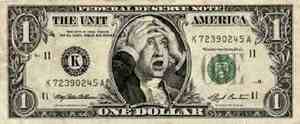
[Tip of the hat to another correspondent who sent the picture of the shocked Washington contemplating his shrinking dollar.]

Posted in ,

13 responses to “Beyond Bar Stool Economics”

  1. spookytruth Avatar
    spookytruth

    DINING ROOM ECONOMICS …
    A group of ten people met outside their favorite restaurant. One was a retired CEO of AIG. He had “earned” 500 million dollars in the last 3 years through hard work and manipulation. One was a wealthy sports star who worked 18 weeks a year and received 20 million dollars a year. One was a small business owner who employed several people and provided desperately needed low wage jobs to the other 7.
    “let’s have dinner, but we must only eat according to what we can afford.’
    The CEO had surf and turf with a nice 500 dollar bottle of wine. the sports figure had a nice steak and a round of shots of some fine sipping whiskey. The small business owner had ravioli and a nice glass of wine. The other seven each had a hamburger and water.
    The next night, the ten met again for dinner. But before entering, the CEO brought up a point. “We shouldnt be borrowing money, and the smart people are debt free. So, tomorrow lets all liquidate all of our assets, turn them into cash, and meet again tomorrow.” They then proceeded into the restaurant for their usual meals.
    The next day, the ten met again Before going in to dinner, they surveyed their various piles of money, both large and small. The CEO then said, ‘Nobody should be borrowing from others. And I’ve been thinking about this glorious war our brilliant president conceived, and I then remembered that it all has been paid for with borrowed money.
    “We have all been equally protected from the shia-sunni civil war, and with long term care for tens of thousands of wounded soldiers, we have spent or committed to spend just about one TRILLION dollars. And it all has been borrowed. now, rough math says that 300 million americans owe about 3,000 each. so, here is my 3,000.”
    The sports star threw his 3,000 in, as did the small business man. The other 7 together had about 3,000 total, so they put that in, and promised to pay their fair share with future earnings.
    The next night, the ten showed up, exepet for one. the chicken processor earning $7.50 an hour told the others that his co-worker, Mr. smith died the night before. He had made it to the hospital in time, but was refused treatment because he had no money (It had been tossed into the pot the night before to pay for the glorious war.)
    The CEO then spoke up and said, “Well why didn’t he have medical insurance. I do, and it covers everything. Sure was nice for me to get free lifetime medical care as part of my golden parachute company. BE PRPARED is my motto.”
    They then prepared to enter the restaurant. But only three could afford their steaks and drinks. The others spent their entire day’s earnings paying back some of the 3,000 they couldn’t come up with after liquidating all of their assets. So they went hungry. but that was fair, because the CEO “earned” his 500 MILLION through 5 years of hard work.
    The next day, the CEO said to the remaining others, “I just learned that the TOTAL debt of the united states is about 10 TRILLION dollars. That means each of our share is about 30,000. Here is my part.” The sports star threw in his 30,000 share. The small business man put in his last bit of capital, then told the other 5 they were out of a job. then the sports star and the CEO went in for a fine, fine, superfine meal and drinks. the others went hungry, but everything was equal per capita in this fine, equal system.

    Like

  2. George Rebane Avatar
    George Rebane

    To illustrate the great ideological and perceptual divide in our country, I was wondering how I would compose the opposing viewpoint. Fortunately, the above comprehensive commentary from Spookytruth covers it very well. The reader can see the gaping gulf and decide for himself, not only the truth of the matter, but also on which shore of the gulf he would like to live. And there is much more to be said about how life will pass on the opposing shores, and who will choose to live on which shore if the population divides along the indicated perceptions of an equitable and just society. Thank you Spookytruth for that excellent comment.

    Like

  3. George Rebane Avatar
    George Rebane

    [gjr 11oct08 – The following comment was received as an email from our dear liberal friend Chris Holland of Grass Valley, and is posted here with her permission. She expects (encourages?) me to reply or counter her “restaurant seat economics”, but I cannot – it speaks for itself and is perfect as written. I stand in awe at all the ways people can view the same world.]
    Hi George – Your blog clip about Bar Stool Economics challenged me to review my own values. I’d like to offer a “raving Liberal” view of economics:
    Ten people (not necessarily men) went out for a meal together. They agreed they’d each spend an hour’s worth of their pay.
    The first four could only afford a child’s portion of mac. cheese.
    The fifth had spaghetti.
    The sixth had meatloaf AND spaghetti.
    The seventh had a three course meal including sirloin steak.
    The eigth had the chef make an off-menu special based on roast duck.
    The ninth had the gourmet menu with foie gras and truffle-infused duchesse potatoes.
    The tenth had a hard time figuring what to get with her hour’s pay, and ended up ordering the 20 most expensive meals on the menu.
    Before the food was served, a gaunt, elderly homeless person walked through the door. The group at first tried not to look. Then one of them said – “let’s just each give a small fraction of our meal, so this person won’t be hungry tonight”. They all agreed that the first four had so little that they didn’t have to give up a single cheesy elbow.
    The fifth said he could spare the parmesan cheese offered with the spaghetti (he was allergic to cheese anyway). The sixth cut off a meatball-size piece of meatloaf, saying “I guess I’m not as thin as our guest”, and the seventh cut off a chunk of steak, feeling good about maybe shedding a few calories for a good cause.The eight donated some salad and one of the four vegetable creations surounding the duck, and the ninth said “don’t serve the pina colada mouse in a grilled half pineapple – give our guest the pineapple, and all the fancy garnishes”.
    The tenth had already asked the chef to box up the 19 meals she wasn’t eating that day, so she just had the waiter bring one of them for the guest, to carry out for later.
    The restaurant owner was so touched that he announced the meals would be discounted 20%. How should that be divided? The first five got meatloaf with their meals, as this was their only meal of the day, and the guest already got way more than they had. The sixth and seventh ordered desert, and each split the extra with the guest just to go along with the initial spirit. The eigth said “I found a loophole – I already gave two items, so I get 20% extra all for me”. The ninth said “you already have more than you need for one meal, but I’d like to get you a gift certificate for 20% of the value of my meal, so you can eat on another day when you have no food.”
    The tenth mused for a while, ordered another of her boxed meals to go with the stranger – and felt so good about what she was able to do that she talked the owner into offering the guest a job in the kitchen. Maybe the first five groused about how much more the guest got, but secretly they thought “there but for the grace of God…” The sixth and seventh resented their “sacrifice” but saw the group considered it to be “fair”. The eighth was smug and fat. The ninth and tenth saw they could change the guest’s situation, at least short-term, and felt so blessed they decided to donate to homeless charities from then on.
    They all survived happily ever after. They gave thanks that they made a difference to another human being, and that they weren’t a group who would sell their grandmother an ARM just to make a profit. A-a-men.

    Like

  4. Wade Avatar
    Wade

    The erroneous assumption in the “Bar Stool” parable is that the benefit of public infrastructure provided by taxes (Court System – 90% percent of which is corporations suing one another while the distribution in funding is roughly inverse, IP enforcement, contract law, finance oversight, free trade deals, military protection for shipping lanes, extraction subsidies, etc. PLUS law enforcement, property protection, incarceration, transportation infrastructure, etc for the brick and mortar enterprises that the wealthy men own shares of and earn money from (at a much lower tax rate than labor income) is equally distributed among the ten men. It, of course, isn’t. Nor is it free.
    The proportionally massive use of these expensive public systems by those who possess great wealth is somehow invisible? It’s a giant subsidy to the wealthy. So yeah, they can pay some more for the beer.

    Like

  5. George Rebane Avatar
    George Rebane

    Erroneous indeed Wade in that the investors and owners of the means of production and wealth creation, served by your list, provide benefit only to the investors and owners, and none to the other people (workers, retired, welfare recipients, government employees, …). In such a world, it would surely be better if the state took over so that a more equitable payment of the beer bill will result. And many believe that in such a brave new world the price, availability, and quality of the beer would also remain unaffected.
    And in case no one noticed in the Bar Stool scenario, these rich already pay quite “some more”, which wasn’t the point of the scenario. The point was how do you distribute the rebate when the bar bill goes down.

    Like

  6. Jonathon Gault Avatar

    Wade, your thoughts are irrational. As a wealth generator myself I would contend that non-wealth generators use far more of the “public infrastructure provided by taxes.” They use the subsided health insurance, welfare, public school system, unemployment insurance, etc while I have never used public assisted healthcare, children went to private school, never been unemployed long enough to collect unemployment insurance… Certainly the wealth generators of today pay far more than their fair share.

    Like

  7. Wade Avatar
    Wade

    Err, Jonathon, you ignored every piece of government infrastructure I mentioned so you can talk about how you’ve never used government supported healthcare? Is that supposed to mean that you don’t use government at all? If you are wealthy you sure do, just not the same pieces as the poor. Classic strawman. And I’m irrational?
    It’s easy to demonize “welfare,” but how much do we spend from the public purse to negotiate, litigate, and enforce say an international trade deal that benefits (greatly) a small class of investors in a particular industrial segment, say aviation? So you’ve never used Medicare? Swell. Most poor people have never used the Federal Courts system for shareholder lawsuits or to pursue patent infringement (and even if you haven’t yourself, the companies in which you own stock do so frequently.

    Like

  8. Wade Avatar
    Wade

    George –
    I did understand that the point was the “rebate” division but I think it’s very telling about the Randian point of view that the implication here is that each man had an equal share of the beer. That is simply not how things work.
    And, by the way, some of us are quite aware of percentages and ratios of tax to income. I happen to know that the combined state + federal + local gross receipts tax on a pack of smokes is a much higher percentage of my income than it is for a millionaire. I’m sure that millionaire would counter that we should all be paying the same total dollar amount rather than the same percentage…

    Like

  9. Jonathon Avatar

    Wade, I tried to include the largest (by funding size) “benefits” of our government. Your list appeared petty when you look at them on basis of size of funding. However, I think a leap is needed to accept that the wealth generators benefit from the nanny government “benefits” you list more so than the poor. Do the “poor” not also benefit from the list you provided? Don’t they get bananas in and out of season (thanks to the benefits you list)? Court appointed attorney’s? Do the poor not use the roads, public transit? Do the poor not care to have their property or persons protected by a cop? I think the total sum of the argument needs to be whether or not the “poor” are better off without wealth generators? Equality is a ridiculous goal. I accept that each man should benefit as his individual personality requires and is able to provide. To loot the wealthy is stealing; and I find virtue in not accepting help from looters.

    Like

  10. Wade Avatar
    Wade

    George –
    So the only things that count as government services are large programs that benefit many people some amount? Smaller (in total size) programs and services that benefit far fewer people a great deal don’t count as government? That’s a bit too convenient for my tastes and I seem to recall something about percentages and ratios being more important than dollar amounts…
    If one government program benefits 10,000 people to the tune of a million dollars and another (admittedly less well known) government program benefits 1 person to the tune of $250,000, I think most people would say the guy getting the quarter million was reaping the benefits of government services far more than any individual among the 10,000.

    Like

  11. George Rebane Avatar
    George Rebane

    I would agree Wade if the sums you cite go to benefit only the people as individuals. I’m not aware of such discrepancies, although, given the complexities of what comes out of Washington, I wouldn’t be surprised if some such thing has happened. Could you be more specific?
    [added 16oct08] And therein lies the crux of the matter between the American capitalist and the collectivist. The collectivist forever looks at how others are doing relative to themselves, and demands that government enforces various forms of equal outcome. The capitalist is busy trying to invest and produce while being pursued by other capitalists and the mob. It’s a tough game that should and does pay hefty rewards if played successfully. As others and I in this comment thread have pointed out, the collectivist gets an enormous benefit from this because he lacks the temperament, brains, or means to start something himself, and must therefore exist on the economic fringes, begrudgingly selling his labor. Others who celebrate the benefits of such wealth generation understand why people worldwide risk life and limb to get here, or emulate our system in some fashion. The alternative has always proven to be a disaster. Paraphrasing Churchill, ‘Capitalism is the worst way to run an economy, except when compared to any other way.’ I am not a market fundamentalist, and do see the need for government to provide a sparse set of firmly enforced rules for capitalists to play under so that a known, predictable, and trusted environment is created for all who want to play. Not enough rules, and a ‘Blade Runner’ world results. Too many rules and the pie shrinks so that socialist rationing and a poor QoL is the result. Most people of goodwill agree that there is some setting in the middle that provides an acceptable balance between equality and liberty. But to my knowledge, no one has yet found a better compromise than we in the US of A. I may not be able to say that a year from now.

    Like

  12. Stacy Avatar
    Stacy

    I feel the need to point out the flaw in spookytruth’s liberal “Dining Room” parable. The guy who employed the poorest got screwed too and took the majority of the group down with him. I realize that we all like to look at the “fat cats” and be angry that they have so much. I realize that there is serious corruption at the top. But those people we love to hate represent a very small group of Americans. If we increase taxes on those making over $200,000 who will be affected? In this day $200K does not go very far, and for those small business owners in the over $200k category a tax increase could result in the end of their business and no more jobs for their employees. This subset of Americans, which could probably be considered upper-middle class as opposed to upper class, is what is keeping the economy alive. They spend money well, make investments, and pay a fair share of taxes. The majority are honest and ethical and will pay what is asked, but they will have to make cuts elsewhere. The economy is in the toilet right now because those people have had to lay off employees and are not spending what they used to.
    I have a radical proposal: leave them alone! Why do taxes need to be lowered at all right now for anyone? Instead of lowering taxes and handing out welfare checks, how about just leaving well enough alone. If there is any need to increase taxes on the wealthy, then do it to the truly wealthy, maybe those making over 500k or 1M.
    I am not wealthy, nor will my taxes increase under Obama’s plan, but the idea of redistribution of wealth is the basis of socialism and I am against it. I come from a lower-middle class background and I work very hard to support my family and have a good life. I have no formal education and have managed to work my way up. I hope one day that I will have a six figure income and resent the idea that I will have to support someone else who did not have my ambition. Why is it my responsibility when they have the same opportunities available to them as I had?
    America – telling you that your taxes will be cut and you will benefit from the economic plan is an election ploy. Remember when Bush 41 said “no new taxes”? Nobody can predict what the future economic needs of the country will actually be. Stop panicking. The economy will improve, it always does. Remember when Bush 43 took office? We had some extra money, so he decided to give some back. Then September 11 happened. We could have really used that money, but it was already gone. Doing something radical after taking office is not really a good idea and panicking when the economy is in the tank isn’t good either. Relax, this too shall pass.

    Like

Leave a comment