

George Rebane
The ancient Vedic philosophers taught that the universe was cyclic and very old. Its age is measured in kalpas for which the Vedantic derivatives of Hinduism and Buddhism have a variety of spectacular 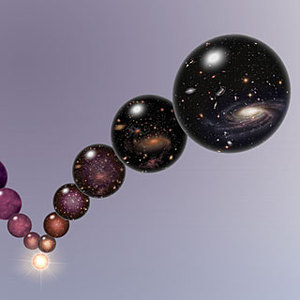 definitions. From my late teen years, my own favorite is the length of time it takes a granite cube, 25 kilometers on a side, to be worn away by an angel who brushes it with a feather every millennium. In one such tradition, the age of the universe is a single ‘great kalpa’ or about 1.25 trillion years. And then what?
Since about fifty years ago we have been told by cosmologists that our universe started with the Big Bang some 13.7 billion years ago from an infinitesimally small singularity of matter/energy/information?, and is now expanding at an accelerating rate. The theory was then expanded to include a Big Crunch that would be the terminal event of our universe when it all collapsed under enormous gravitational pressure into a similar kind of singularity (not to be confused with The Singularity). All this was still one big cycle or perhaps no cycle at all, it could keep expanding forever as one cold, lifeless, and unbelievably large volume of sub-elemental particles (proton decay) – but still be one long event.
When I studied about this during my years as a physics undergraduate, I was deeply disturbed about such a collection of one-shot universe theories. It was simply unsatisfying; in my gut I wanted the universe to be cyclic as taught by the ancients – everything we perceive has its oscillations of birth-death-birth-death-…, why not also the biggest thing we know about? My hopes were partially satisfied when cosmologists began seeing in their equations the possibility of multiple universes existing in the cosmos. Ours was just one of a countless number of these which would pop into existence and then either end in a crunch or dissipate like a puff of smoke.
Then we began learning that there is evidence that our universe – and presumably all other universes – are indeed cyclic (see Martin Bojowald’s recent work). They explode and crunch, explode and crunch in a kind of bouncing mode of existence. The latest evidence for this comes from a team of physicists who are reconciling quantum mechanics (that describes the micro world) with relativity (describing the macro world). And more of a wonder, it comes by looking at time and space not as a continuum – something you can keep chopping into smaller pieces without end – but each as made up of very small but discrete chunks.
The change in the mathematics required to describe such a state of affairs (differential to difference equations) reveals that our universe did not start from an infinitesimally small volume, nor will it return to one as things come back together. In fact, the dimension of the smallest volume during this bounce can be calculated and its properties examined. The bottom line is that during the extreme of the crunch, space itself is squeezed so that gravity changes sign (from pull to push) and the whole shebang turns into something like a compressed spring which then explodes outward to start the next universal cycle.
John Wheeler of Princeton (died April 2008), one of the great physicists of the last century, took as his final research project the enquiry ‘Why Existence?’. This, at least to me, is about as far as you can go in physics. Note that the question is teleological, Wheeler wanted to plumb down below the last turtle (remember ‘It’s turtles all the way the down!’) and discover the purpose for it all.
Puzzling on this, I imagine all of ‘what is’ being stepped through an essentially infinite set of parallel difference equations to create us and all we experience, and every bit of existence that we will discover in the years to come. In short, with every new discovery I become more convinced that all this is running on some cosmic computer. And whoever wrote the code to create Existence wants us and others to understand that this is an ordered and discoverable universe. It seems that we live in a sea of unmistakable invitations to learn ever more about what ‘this’ really is, and, perhaps, finally get to answer our ‘why?’. Amen.
 rebanesruminations.com
Leave a comment