

George Rebane
I’ll step right out there and put my foot in it – there is not a single significant area of human endeavor that is not a strong subscriber to or totally transformed by systems science. Yes, but how do you define ‘significant’? I define it simply as the domains of knowledge that are important to 99.99% of humans, and this ranges from the Batwa pygmies in the jungles of Uganda to the post-doctoral workers in biology labs everywhere. Now there isn’t a single field such as sociology, anthropology, history, political science, law, chiropractic, … that in some way does not depend on the tools of system science for its existence and advancement. We don’t need to labor that for decades these tools have been firmly embedded in the hard sciences, the military, and industry.
My August copy of the Proceedings of the IEEE arrived recently and its cover proclaimed it a “Special Issue” devoted to “Computational Systems Biology”. Perusing the invited papers from leading researchers, it was clear that if you want to push back frontiers in biology you had better either know systems science or have a colleague who does. Apparently, as a biologist you can’t just cross-pollinate ferns, count bacteria, or carefully dissect salamanders any more. Those readers confused as to what systems science is all about, I refer to the excellent Wikipedia summary here.
But the important point to make is that system science is the body of human knowledge (‘rules underlying rules’) that also lets us understand complex matters of how people make (good and bad) decisions and manage their affairs that in the modern world are ever more co-dependent. System scientists have a hard time communicating their sometimes alarming results to political leaders because there are probably fewer than one in a thousand politicians who know anything about this field through which we now have the best understanding and clearest interpretation of almost everything around us.
To confirm this, look at the floor and committee speeches/debates on CSPAN. Everyone nods to the notion that all issues are composed of interconnected factors. Yet, listen to their words and look at the ridiculous laws that are passed. Admittedly, on TV they talk to the great unwashed, but their legislative product is still written as it is sold – it is based on simple one-to-one connections, ignoring the manifold complexities of the matter which might even advise leaving things alone. I can hear you say, “But the sheep always demand that ‘something’ must be done, so the politicians must do ‘something’.” Well, yes.
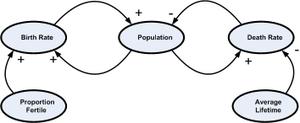 In these ruminations I have suggested that some progress in public understanding might be had with a picture – a graphic of how the various factors of any issue are related – that supports a reasoned discussion. Possibly the simplest tool in the systems science kit is the influence factors diagram or IFD (more here). It doesn’t take any mathematics or other technical knowledge to understand because an IFD is simply a collection of already known and easily grasped factors connected by arrows showing how they influence each other. But dare to draw or present one of these IFDs during a public workshop, and you are immediately discounted by the smugly smiling audience as a hopeless propeller-head who doesn’t know how to communicate with real people. And what passes for dialogue goes back to the rehash of singly-connected factors accepted or rejected through snappy slogans, deft (daft?) one-liners, and the recounting of emotional anecdotes.
If this were the experience with only off-the-street illiterates and innumerates, we might have a chance. But the drill is repeated daily in chambers of the elected councils across the land. The strong corollary to this message is that if you don’t understand the IFD that describes the issue, then you don’t understand the issue. The remedy I am suggesting is just a very modest beginning – learn to interpret and use an IFD. It would at least keep reminding the discussants of a more clear and complete picture of why they are together in a room.
In sum, system science benefits the good people of this land in almost every other area that affects them except in their own governance – except in that enterprise which determines how they are taxed, regulated, and willingly herded into ever narrower corridors of state-dictated behavior.
“Nobody stole, nobody grumbled over his rations, the quarreling and biting and jealousy which had been normal features of life in the old days had almost disappeared.” Animal Farm, George Orwell.
*** 6aug08 –
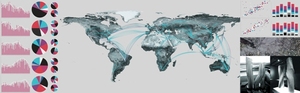
The recent article titled ‘The Next Big Thing in Humanities, Arts and Social Science Computing: Cultural Analytics’ by Kevin D. Franklin and Karen Rodriguez’G introduces yet another new application area for systems science. As cultural analytics matures and produces fresh explanations and reliable predictions of social behavior, we may yet see the penetration of systems science into the processes of participative governance.

 rebanesruminations.com
Leave a comment