

George Rebane
Community planning and economic development of small counties like ours is often detoured and dead-ended by debates that lack a factual basis, or worse, based on myths generated by agenda-ladened 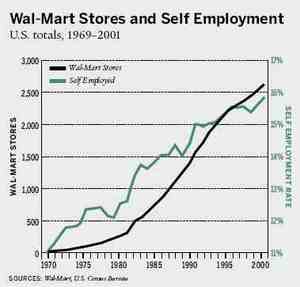 activist groups and propagated by the MSM. The location of big retailers like Costco and Wal-Mart in communities always brings out the warring factions. The advent of Costco in nearby Auburn (see NC Media Watch) will again light the torches and people will gather with pitchforks and scythes in front of our town halls at midnight. They usually wind up protesting that small businesses will be destroyed and the community will lose jobs. But is that what really happens?
Andrea Dean and Russell Sobel (“Has Wal-Mart Buried Mom and Pop?”) have done what appears to be a thorough econometric analysis of the community impact of this big retailer, and the results from their work will surprise you. They write –
Many believe the mega discount store Wal-Mart is a plague set upon small “mom-and-pop” businesses. The instant Wal-Mart moves into town, all small businesses are destroyed in its path, leaving downtowns barren and empty. This popular misconception has garnered significant media publicity and widespread public acceptance.
The real effect is more complex, and has been mis-analyzed as Dean and Sobel point out.
Our research finds that a new Wal-Mart store results in both the immediate failure of some small businesses and the emergence of other small businesses — both in other sectors and in other counties. For example, if a new Wal-Mart store opens, causing a directly competing hardware store to close and subsequently a new antique boutique opens in its place, the previous studies would only observe the failure of the hardware store.
They re-introduce us the concept of creative destruction that occurs whenever significantly novel technologies, processes, or methods are introduced into a free society.
New inventions, for instance, often result in the business failures of products supplanted by now outdated technologies. That is unfortunate for the old businesses, but it benefits consumers and it frees money and resources that can then give rise to new businesses and further advancements.
The report goes on to detail what has really happened in communities after Wal-Mart’s arrival. Specifically, how much money households save and what effect it has on local jobs and business development.
…the opening of a new Wal-Mart store results in city-wide price reductions of nearly two or three percent in the short run and approximately 10 percent in the long run. Consumers will spend at least some of that savings at other small businesses.
Dean and Sobel state that these and other related effects have been ignored by previous research that has been widely reported in the MSM. They strongly state that
(j)ust by looking at the raw data, no evidence can be found to validate the arguments of previous Wal-Mart literature. Wal-Mart’s alleged negative effect on the small business sector simply cannot be found in the data. However, many factors can change over a 30-year time period. For example, mom-and-pop businesses may have developed Internet-based services that would make it easier to survive in the marketplace, thereby hiding the alleged negative effect of Wal Mart. Because of such changes, a more rigorous cross-sectional analysis at a single year in time is necessary to draw a more firm, concise conclusion on Wal-Mart’s true effect on the U.S. small business sector.
And after many well-laid-out supporting graphs, charts, and tables of data, they conclude with –
Our research suggests that the popular belief that Wal-Mart has a significant negative effect on the size of the mom-and-pop business sector of the United States economy is statistically unfounded. After examining a plethora of different measures of small business activity and growth, examining both time series and cross-section data, and employing different geographic levels of data and different econometric techniques, it can be firmly concluded that Wal-Mart has had no significant impact on the overall size and growth of U.S. small business activity. There is no question that Wal-Mart does cause some mom-and-pop businesses to fail. However, those failures are entirely compensated for by the entry of other new small business elsewhere in the economy through the process of creative destruction.
The entire 714KB pdf report is published by the Cato Institute and may be downloaded here.


 rebanesruminations.com
Leave a comment