

George Rebane
When the overwhelming fraction of voters consists of people indifferent, ignorant, or just plain stupid, how does a republican form of democracy work? Why doesn’t it just collapse right away as such people cast ballots?
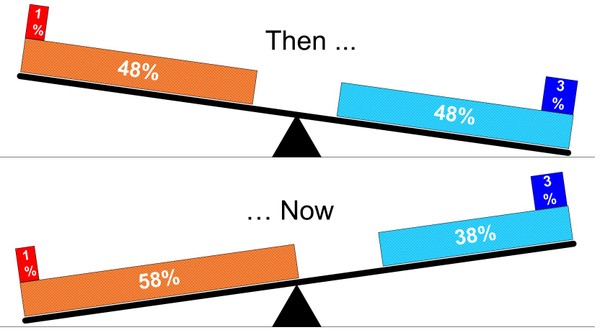
Political scientists have studied this remarkable stability of democracies, and have noticed that somewhere in the 20th century something was beginning to break down – voters around the world were voting for policies that clearly were not best for them or their country. To understand what was happening, we need to back up a bit.
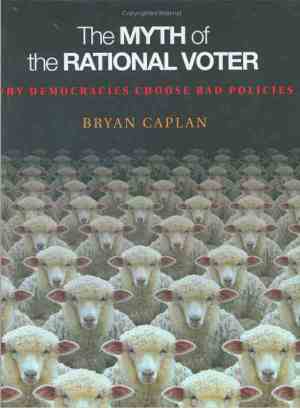 In 2007 Bryan Caplan wrote The Myth of the Rational Voter – Why Democracies Choose Bad Policies. In this impressive essay, Caplan, an economics professor at George Mason, reports on studies showing that the ‘Miracle of Aggregation’ has broken down. Saddled with voters of moderate motivations and means, this ‘miracle’ is what apparently kept democracies going for almost two hundred years. Then with the advent of mass broadcast media in the 1920s, things began to change.
The basic principle behind the Miracle of Aggregation (MOA) was that the ignorant, indifferent, and stupid people – comprising the overwhelming mass of say, about 19 out of 20 – pretty well split themselves at the ballot box on issues and candidates. Their votes were generally not based on any consistent, coherent, or compelling thesis, and therefore they divided themselves equally over the presented alternatives. The remaining voters, according to the MOA, were the diligent and intelligent voters who cast their votes based on arguments grounded in defendable reason. So if the big mass split themselves evenly, the smart voters who did their homework would determine the usually beneficial outcome. This result is shown in the top seesaw of the figure where 96% of the voters lack the three Cs mentioned above, and the remaining 4% are blessed with such qualifications.
With the advent of mass media, everyone could have access and be exposed to campaign ‘literature’ that didn’t even require a modicum of literacy to understand. Now everyone would be exposed to messages, short (preferably) or long, delivered by authoritative personages or even favorite entertainers and athletes. Everyone could feel that they could see into the essence of the issue and decide the right way to vote. And such convictions became stronger as the media messages were repeated day in and out.
Politicians, using some back-up from academia, quickly learned that if they could just sway the ignorant and mentally lame, they would easily overwhelm that bothersome minority of voters who kept asking those embarrassing questions and demanding substantive answers. It wasn’t long before ‘Madison Avenue’ began to equally serve candidates and cereal companies because they could demonstrate the effectiveness of what now has come to be known as the properly positioned sound bite. To torpedo the MOA, go directly to the masses – ‘don’t think, just emote and vote’.
By the 1930s such voter communications became the grist of electioneering – all that it needed, according to the psychologists and statisticians, was money. For when you had money, and lots of it, you got the desired effect shown in the bottom part of the figure (percentages exaggerated, but not too much). In short, with sufficient media coverage you could overwhelm your opponent by causing a massive shift in the more or less mindless mass, and make the small fraction of intelligent voters irrelevant in the election.
In recent decades the US Government Department of Education has provided what may be the definitive nail in the MOA’s coffin – Literacy in the Labor Force: Results from the National Adult Literacy Survey. Here we learn the real stats of our literacy limitations and get a hint of how almost totally innumerate we are. Numeracy is the collection of tools that a (non-technical) person needs to be able to understand numerical data, do arithmetic, comprehend logical arguments, and interpret graphical displays of information in everyday media. And our political and legal cadres understand these deficits very thoroughly. Today ALL issues are dominated by numbers which serve to roll the eyeballs of the innumerate.
So now we have some science and academic weight behind what we have suspected for years. The MOA’s death explains why cash has been king in politics and tomorrow will be emperor – because that is what you need in abundance to sway the sheep and today the sheep determine the election outcomes. If the politicians only had to present arguments of verifiable fact and defendable reason, then it would cost a comparative pittance to prepare issue position papers, media spots, and real debates with considered answers (not stand-up one-liners in real time). The whole thing could be published on the web, and be available at the schedule and to the depth that each voter can handle.
RIP Miracle of Aggregation.


 rebanesruminations.com
Leave a comment