

George Rebane
We arrived in Tartu – Estonia’s university city – early this afternoon after a short 40-mile drive from Viljandi that passed by Võrtsjärv, Estonia’s largest lake. Again, it was a beautiful drive along a countryside where every community has assembled the makings of the annual and traditional very large ‘John’s Day’ bonfire. This is the summer solstice weekend which in 2008 gives the Estonians a four-day period of merrymaking and we can already hear groups of young men belting out traditional and not-so-traditional songs in the big town square in front of Tartu’s impressive city hall – a rendition of the Beatles’ ‘Yellow Submarine’ just ended.
We settled into the hotel and then got directions to go on another discovery trek, this time to find the location of where a well-known and oft-described 1936 photo of my uncle Ralph and his girlfriend. We found the location, but that’s another story. On the way there we stopped for a picnic lunch at a park across the small lake that separated us from our destination. Seeking a place to sit down next to the lake we ran into the abomination of a war memorial pictured below.
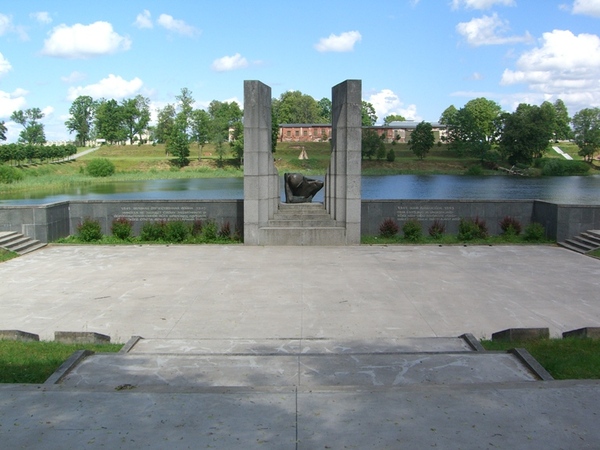 Carved in stone are commemorative lies in both Russian and Estonian –
“1941 Great Patriotic War 1945 – Our defenders and liberators, the sons of all the peoples of the USSR are gratefully remembered forever by (the people of) Tartu.”
Such monuments are a blight on the Estonian countryside and a reminder of a wound that has little chance of healing. Estonians who witnessed and lived through the horrors of Soviet occupation would tear down such monuments in a heartbeat. However, the Russian ethnic minority would then riot as they did last year when such a monument in the center of Tallinn was only moved to a less prominent place. This incident launched the first cyber attack by one nation against another when denial-of-service messages from Russia flooded the Estonian internet servers and sites. With the help of a multi-national team that included US experts, the attack was thwarted and now Estonia is the site of a new institution in which such tactics of future IT wars are studied.
But before getting to the main point of Estonia’s open wound, I’d like to give a little background from a reference that my friend Russ Steele of NC Media Watch coincidentally sent me a little while ago. He cites the article ‘Will Estonia liberate the United States?’ by Nicholas Kaster in the American Thinker which considers the strife between the two dominant American economic ideologies. Kaster states –
“For Estonia, the 20th century was a litany of horrors. A victim of the 1939 Nazi-Soviet “nonaggression pact,” the tiny Baltic nation was invaded three times during World War II: first by Soviet Russia in 1940, then by the Nazis in 1941, then again by the Soviets in 1944.
After the war, the Soviets transformed Estonia into a “Soviet Socialist Republic” and attempted to strip the Estonians of their national identity. Through the process known as “Russification,” a half million Russian migrant workers were brought to Estonia. Meanwhile, 70,000 native Estonians fled to the West, while tens of thousands were killed or deported to the Siberian gulag.”
I am part of the 70,000 and, of the half million Russians, 300,000 of them still live in Estonia. Today 40% of Tallinn’s population is still Russian assuring that the nation’s capital has a socialist mayor who was a prominent communist during the occupation. This mayor is proposing that the state take over some industries and open up a chain of food and fuel stores just for the ‘poor people’. He and his Russian supporters yearn for the days before USSR’s collapse without ever stopping to ask why did such a regime collapse in the first place.
Kaster cites the history and mindset of people emerging from a command state, a condition many in our country would like to have us achieve.
“(Mart) Laar, who became Estonia’s first prime minister in 1992, inherited the bitter fruits of socialism – an economy in shambles and the citizenry dispirited. “In an era of socialism,” Laar wrote, “people were not used to thinking for themselves, taking the initiative or assuming risks.”
This was a problem common to Central and Eastern European countries. In a recent article for the American Spectator, Washington Post columnist Anne Applebaum observed that “[i]n a very short time, between the late 1980s and mid-1990s, much that had been illegal in that part of the world became legal again.” But the private, charitable, and social institutions that form the fabric of a civil society had not existed for many decades. Without civil society, Abblebaum wrote, citizens “lost of the habit of organizing anything, whether economic activity, entertainment, education, politics, or charity, for themselves.”
Estonia was no exception. As Laar himself noted, citizens “had to be shaken free of the illusion-common in post-communist countries-that somehow someone else would solve their problems for them.” Accordingly, “the government declared that it could only help those who were prepared to do something for themselves.”
I witnessed this first-hand when my cousin Peeter visited us in 1988. This was a man whose gumption-quotient was almost zero. Socialism had turned him (and everyone else) into the complete cynic sitting on his butt; his favorite aphorism of the state was, “They pretend to pay us, we pretend to work.” It took a while for the gears of initiative to get cranking again, but soon after independence they did get cranking. Kaster continues –
To get the gears cranking, “… Laar, an acolyte of the late economist Milton Friedman, embarked on a series of radical free market reforms. First, Estonia privatized state assets and established laws that clearly protected property rights. Second, it abolished all import tariffs and became one big free trade zone. In addition, Estonia stopped state subsidies to failing enterprises. Private enterprise had to work efficiently or die. Third, a flat-tax was established, with a uniform rate of 26% regardless of personal income. In January 2005 the personal income tax rate was reduced to 24%. A subsequent reduction to 23% followed in January 2006. The income tax is scheduled to decrease by 1% annually to reach 18% by January 2010.
Supply-side economics is very controversial in the West, but Laar has little doubt of its effectiveness. “The flat-rate tax has been an important part of the Estonian success story,” he said. “it’s easy to collect and easy to control.” The only losers, he noted, were the tax lawyers.”
So now The Heritage Foundation rates Estonia as the 12th freest economy in the world and getting freer. You have to see what this nation has done in sixteen years to understand what economic freedom can do and how rapidly it can work. The pendulum swings both ways dear Reader, start reducing economic freedom and things begin going to hell real fast. We’re not talking theory here.
Kaster sums it up –
“Estonia’s embrace of free enterprise, private property, and low taxes were built upon the Reagan-Thatcher vision of the 1980s. The supreme irony, of course, is that, while Estonia (and other Central and Eastern European countries) are taking Reaganism even farther than Reagan could, the U.S. now seems headed down the road of collectivism and higher taxes. As Central European countries are slashing tax rates, Barack Obama promises to raise the U.S. marginal income tax rate and to nearly double the capital gains tax. While the former communist countries are discovering the virtues of privatization, Democrats in the U.S. (and some Republicans too) are seeking a more expansive role for the state.”
So, Estonia has its ethnic Russians who are its visible fifth-column militating for the country’s return to strong-state socialism and, eventually, into the embrace of mother Russia. To see what a people can do when the state gets off their backs, one should come to this little land, drive its roads, visit its spotless cities and villages, and go into its shopping centers. Meanwhile we have an entire cadre of politicians who this year are promising to solve problems the source of which they have no clue. And the common denominator of all their solutions is to continue cutting back individual freedoms – ‘we will take your money and make everyone happy’.
Finally, in the picture you can see a large structure that looks pretty bad. It is the ruin of one of the most beautiful manor houses in the country that was destroyed by the Red Army at the end of WW2 and is now being rebuilt to house the Estonian National Museum. The manor and its grounds were already a city park in the 1930s. The ruined front of the manor faces the lake and had a fine terraced esplanade that overlooked that peaceful pond. We found the earthen work boundary of that esplanade where the photograph was taken – you can barely see it across the lake to the right of the rightmost sticky-up part of the Soviet memorial.
And the thing that looks like a teepee right above the memorial’s sculpture is a huge pile of old lumber, like countless others across the land, that has been prepared for the John’s Day bonfire to be lit Monday night amid a lot of dancing, singing, (and yes, drinking), and general carryings on of a free people. We plan to be there with them.
 rebanesruminations.com
Leave a comment