

George Rebane
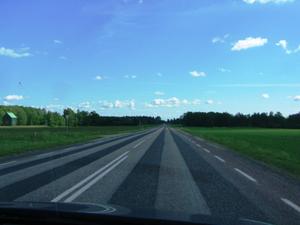 Yesterday morning we left a rainy Tallinn and drove south toward my birthplace Viljandi. The country outside of the capital continues the style, wealth, and mood of the capital – the highways, fields, and forests are modern, well-signed, and as neat as a pin. Estonia is, perhaps, the only country in history to refuse US aid after liberation – they didn’t want to become dependent on a very addictive teat. The land now compares favorably with Germany and New Zealand, places where people take pride in where they live. The only reminders of a tragic past are the Soviet built factories, processing plants, and workers’ apartments that startle the eye when encountered – the products of socialism resemble pieces of crap no matter where you encounter them. (Witness ‘the projects’ of
 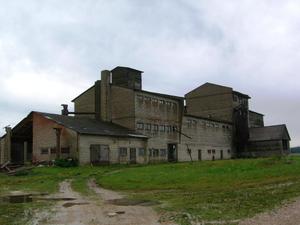 government housing in our own fair land.)
Before reaching Viljandi, we stopped to discover and visit important places in the Rebane family history that were located a few miles off the main highway. Again, the country roads are in meticulous condition as are the fields and villages off the beaten path. We saw the community of my maternal grandparents who operated the local windmill that ground the local grain before WW2. Lots of pictures and tromping around old churchyards.
Then we found the graves of my paternal grandparents – I was named Jüri Rebane after my paternal grandfather (how I got to be George is a long story). This involved a search through two grave 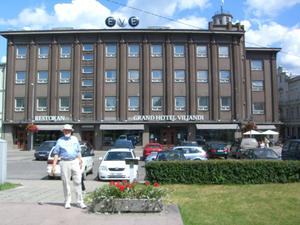 yards required some serious time wandering through weeds and broken masonry crosses. Tending Christian graves was frowned upon during the occupation and things do go to seed after sixty years in a country as lush and green as this.
In the late afternoon we finally pulled into Viljandi, a community of about 20,000 which is the capital of the Viljandimaa province. Jo Ann had booked us in the Grand Hotel which was completed in 1938 and in which my mom worked after I was born. There she met her lifelong friend Rita who became part of our family as we escaped to Germany in 1944 and was with us when the war ended in 1945 – she emigrated to Canada and lives there now. We have had a picture of them both at a 1941 employees’ luncheon in the hotel, and last night we confirmed that the picture was taken in the existing main dining room of the establishment.
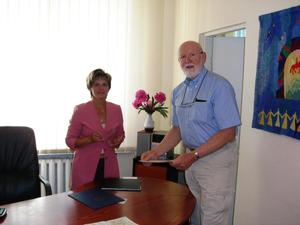 This morning we hit the jackpot at the provincial administration center. We were able to dig up the directors of family affairs and land affairs. Discovering that I was an expat Estonian, still fluent in the language, launched two sequential sessions of discovery that brought smiles of professional pride to them and of deep gratitude to us. My formal existence since 1944 has been grounded on a copy of my birth record that has been almost folded into pieces. It got me into the US, made me a citizen, allowed me to fool the US Army that I could be an officer and a gentleman, and permit the US security agencies to grant me some of the highest security clearances in the land. Today Director S. Tamm was able to locate the actual volumes where not only the handwritten record of my birth still existed, but where she also discovered additional records about my parents and grandparents. This was again a demonstration that autocracies never discard any piece of information, they just classify it and put it into an archive.
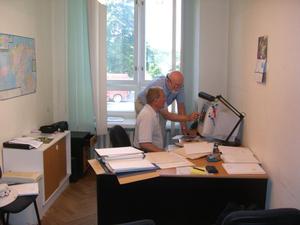 Then she took us down the hall to meet Director E. Laukse who has been in charge of all Viljandimaa land records since (re)independence in 1991. Our goal was to find and visit the original Rebane farm. This proved more difficult, and, cutting to the chase, was made possible only when I mentioned my out-of-contact cousin Peeter. It turns out that he successfully applied for return of the farm and is now its legal owner. There is more to the story which is best left untold. In any case Mr. Laukse was extremely helpful and dug out old folders pre-dating WW2 and other records as the Soviets had stored them. We got close enough in the paper records to go into the online Estonian national land database and pulled up all the data on the old ‘Posti’ farm (farms in Estonia also have their own names separate from their owners).
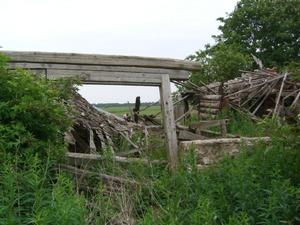 Armed with maps and GPS coordinates, tonight we drove back to add some candles to my grandparents grave (a custom here) and then to the old Rebane family homestead. There we found the ruins of my grandparents house (everyone was moved into communal houses when all the lands became collective farms). We have two photographs – one with me in my mom’s lap – of my grandparents in front of that house. We then walked the fields and forest parcels of the farm that together comprise about 30 hectares (about 70 acres). Today cousin Peeter has leased the land which is pushing up a large and healthy crop of rye.
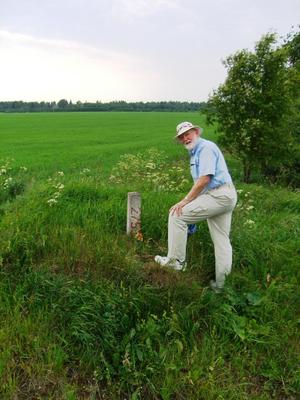 Before leaving, I buried a greeting to Peeter in a plastic water bottle at the base of the official survey marker located near the corner of the farm next to a county road. It has a little pot of bright artificial flowers on it to draw someone’s attention to it. Perhaps we will hear from him some day.
To complete this record, today we also met Rita’s brother who is a surgeon at the Viljandi hospital. He took us to lunch at a local Armenian restaurant (the Estonian speaking Armenian wound up here after his service in the Red Army and is not going home) where we were treated to the best meal we have had since getting off the plane – we love Armenian food! We talked all afternoon comparing notes and covering a multitude of topics on the war experience, the Soviet years, and Estonia’s ‘Russian problem’ – not a list of happy topics, but revealing ones that I will be reporting on in the future.
It’s almost midnight – aaarghh!!


 rebanesruminations.com
Leave a comment