

George Rebane
Have you heard of cognition-enhancing drugs? Well, if you drink coffee, then you’ve been taking one probably for years. But now we’re getting into some serious new drugs coming to you from big pharma 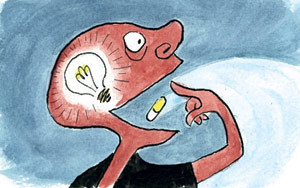 that promise to keep you alert, focused, and improve your concentration and memory by leaps and bounds.
The technology notices I get from various professional societies, future studies groups, etc. have been for some time talking about the use of drugs to shift our brains into the next higher gear. Now this news is becoming a torrent and the drug industry has a number of concoctions in the labs that they will soon (next 5 to 10 years) be offering to us. No less than the 24may08 issue of The Economist has a major article (‘All on the mind’) detailing the need and the trend toward these mind pumpers.
To understand what’s happening, you have to separate these drugs from the stuff the cartels are importing from Mexico, and what the do-it-yourselfers are cooking up in suburban bathrooms. The cognition-enhancers are good for you and your mentally intensive careers. Some scientists and academicians are already into so-called “off label” use of drugs like Ritalin and Provigil that were developed to treat mental maladies like ADD and Alzheimers. It turns out that these drugs mess with your neural wiring in ways that also benefits healthy people. Such extra-curricular uses are now reported in the pre-eminent science rags like Nature.
Scientists are zeroing in on specific neurotransmitters that are critical to important brain functions. Given that the bundles of neurons between our ears can be thought of as digital circuits switching ‘on’ and ‘off’, the researchers are focusing on neurotransmitters that do or help such switching. From The Economist –
One such neurotransmitter is glutamate. This throws switches to the ‘on’ position in memory-forming circuits. Members of a newly discovered class of compound, ampakines, boost the activity of glutamate and this makes it easier to form memories.
A California company, Cortex Pharmaceuticals, is one of the firms developing ampakines for treatment of Alzheimers. One of its early drugs is already showing promise in testing, and it’s not lost on these folks that the market will be bigger than just Alzheimers sufferers.
Cholinergic neurons (say that fast three times) are those which respond to the neurotransmitter acetylcholine and are “involved in concentration, focus and high-order thought processes, as well as memory. It is the cholinergic system that degenerates in Alzheimers disease.” So, of course, various approaches involving acetylcholine are now being concocted in the labs. The article concludes with –
Mind-expansion may soon, therefore, become big business. Even though drugs have been developed to treat disease, it will be hard to prevent their use by the healthy. Nor, if they are without bad side-effects, is there much reason to. And if that is so, there may be a very positive side-effect on the profits of their makers.
No kidding Red Ryder! Now that learning and retention promises to be easier, they should also start work on a pill that will motivate our young people to learn something to help them get a good paying job in the private sector.
So there you have it. On one side the pharmas will soon have us taking smart pills regularly – especially those of us rich in birthdays – and the chip makers will have us buying implants that will enhance and regulate the function of damn near everything in our bodies. And this is just the preamble to what the genomics people will eventually pull out of their hats to beneficially mangle our double helix – all this so that we will be ready when the first machine taps us on the shoulder and says “Hello, I am here.”
====== 25may08 update – One of my longtime friends from southern California and a nationally-known academician sent me an email re this post. I abstract the following from that email.
“Drugs proven to benefit Alzheimer’s sufferers might be considered cognition-enhancing. And good old ginkgo-biloba is thought by legions to improve functions of the mind.
Here’s are some things the Mayo Clinic’s excellent online drug/supplement pharmacopeia has to say about g-b: Ginkgo biloba has been used medicinally for thousands of years. Today, it is one of the top selling herbs in the United States.
Ginkgo is used for the treatment of numerous conditions, many of which are under scientific investigation. Available evidence demonstrates ginkgo’s efficacy in the management of intermittent claudication, Alzheimer’s/multi-infarct dementia, and “cerebral insufficiency” (a syndrome thought to be secondary to atherosclerotic disease, characterized by impaired concentration, confusion, decreased physical performance, fatigue, headache, dizziness, depression, and anxiety).
I’d tell you how much to take, but I forgot – or maybe I just claudicated!”
As you can see, not all these mind enhancers are uniformly effective 😉

 rebanesruminations.com
Leave a comment