

George Rebane
For the Steeles and Rebanes this was the last day together on our RV trip without an RV. We decided to do a little research on community development from an historical perspective and took a 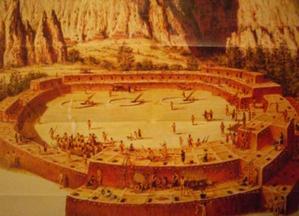 trip to the Bandelier National Monument. There we were promised the opportunity to discover and examine the lifestyles of the Anasazi Indians who settled in the region more than 10,000 years ago. From a perusal of the pictures depicting the ruins of their settlements it was clear that we would find the progenitors of smart growth. This is apparently where community planning started. The deep interest in such an approach to communal living in Nevada County left us no choice but to conduct our own investigation up close and personal.
The drive from Santa Fe into the high country of mesas and pines was spectacular. We stopped for 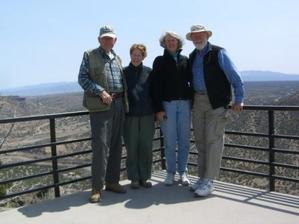 lunch at the White Rock overlook high above a pristine Rio Grande which at this point is still innocent of hindering immigration to this land of opportunity. From there we passed the gates of Los Alamos National Laboratory wherein are designed and fabricated other little artifacts to definitely hinder unbridled immigration. In this case we didn’t want the Red Army to do the immigration two-step, first into western Europe and then to the United States.
Onward then over the tops of pine and juniper covered mesas, finally diving down into Bean Valley, or for you multi-lingual types, into Frijoles Valley where the main visitor center is located. After visiting the shops and a slide show we were ready for the trail that would lead us up the 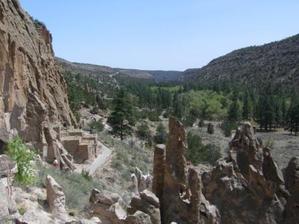 canyon to the ruins of the large Anasazi settlements. The Anasazi are said to be the pre-Spanish ancestors of the modern Pueblo Indians.
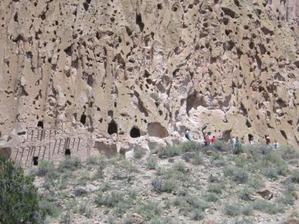
The trail is really very well done taking us along the wooded valley floor by giant kivas and circular condo type villages. Then the trail climbs high into the south facing cliff where more people lived in caves dug into the soft rock and in rows of attached housing built from stacked stones glued together with mud.
According to the archeologists and anthropologists who study such things, we know that the Anasazi lived for about 9,000 plus years in what today we call sprawl. These unenlightened “people lived in small scattered settlements of perhaps one or two families each.” For generations things were going swimmingly until one day a couple of guys came back from one of those west coast liberal colleges where they had learned all about managed growth.
 They made a pretty big splash by giving stand-up presentations in the local kivas about how the Anasazi should really organize their communities so as to protect and sustain the environment. Some of the knuckle-draggers in the group tried to point out that the environment had been sustained and protected pretty well for the last handful of millennia. But the progressives shouted them down – ‘Hey, what do you turkeys know?! Sam and Harry just got their masters in community planning and Harry even did his thesis on smart growth.’
No one quite knew what smart growth was, but it sure sounded a hell of a lot better than dumb growth which the educated pair assured them that their people had been doing from the dawn of 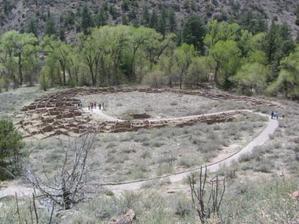 time. They even gave it a name – sprawl – which didn’t sound very progressive at all. Sprawl reminded them of what position of decrepitude you assumed after drinking a wee too much of that fermented cactus juice. No more sprawl for the Anasazi.
Sam and Harry laid out the plans for smart growth and, I guess, the rest is the history of how it all worked out. “As the population grew, people began coming together in larger groups, and, by the mid-1200s, villages often included as many as 40 rooms. The following 250 years saw fewer and larger villages, with some exceeding 600 rooms.”
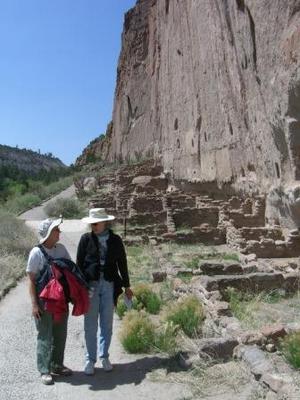 Then suddenly somebody pointed out that smart growth was no growth at all. These large villages required denuding all the trees within reach, and replanting beans and corn and squash in the same place season after season that kinda made the land yield less and less. Nobody knows exactly what happened, but by the mid-1500s the Anasazi “who lived there had moved on”.
Well, they did more than just “moved on”. These people were a bit ashamed of what they had done to Bean Canyon and other places they had lived. They actually changed their name to the Pueblo People and denied ever having known the Anasazi – ‘Yeah, we heard they lived somewhere up in them canyons. But they were kinda sickly and scrawny as the years passed, we paid them no mind. We don’t know what happened to ‘em. Now about these blankets … .’
Russ and I with our wives looked high and low for evidence of what really happened, but all we found were the tightly packed ruins of smart growth. The trees along Bean Creek have grown back, but the ground still looks a little pekid, I’m not sure that much would grow here today without gobs 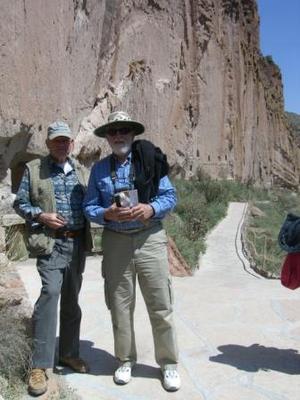 of modern agricultural chemicals and such. Russ and I were particularly keen on finding some remnant of the statue of Sam and Harry they must have built when all the fuss about smart growth started. But seeing as how it didn’t turn out all that well, we can understand why they didn’t want to leave any sign of it still standing.
Having concluded our research, we then drove back to Santa Fe to have our last night together. This trip has been most fun, congenial, and entertaining. Russ and Ellen will now continue eastward on their epic three-month journey across the continent and back. I can already hear the troubadours of Nevada County composing paeans recounting the adventures of that intrepid pair of lovers. We decided to have our goodbye dinner at Harry’s Roadhouse south of town. We’re not sure whether this fine eatery was named for one of the progressive Anasazi pair, the one who did his masters thesis on smart growth.


 rebanesruminations.com
Leave a comment